
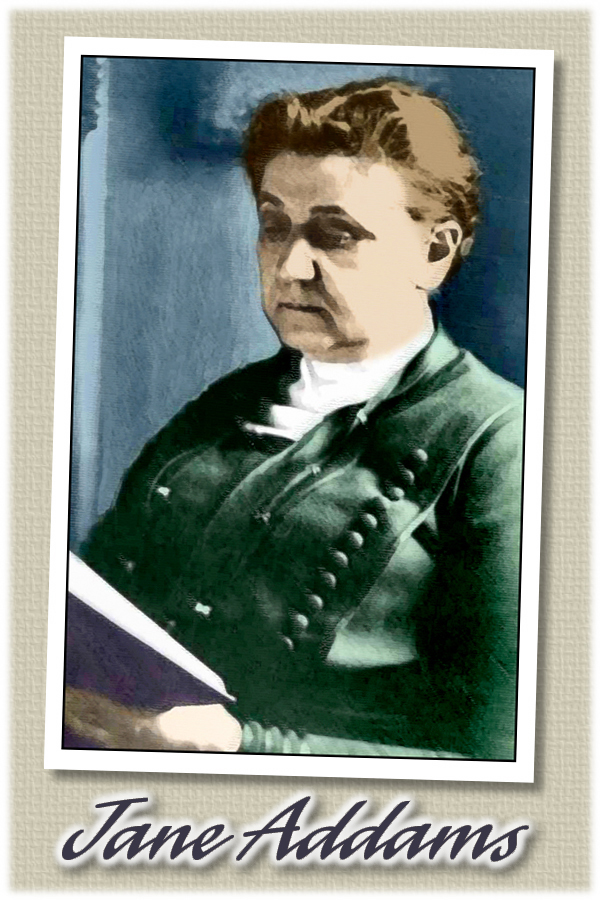
In 1889, Chicago was leaving the Gilded Age and entering an era of rapid industrial growth.
Iron, steel, steam railroads, shipping, and telephones begot new tycoons who created millions of new jobs which lured a million immigrants a year to fill them. Into this rich industrial mix, immigrants joined working Americans in clamorous slums full of crime and disease. Privately funded reform movements emerged to improve these conditions.
Jane Addams (1860-1935) was such a reformer, who opened Hull House in 1889. Purchased with her inheritance, Addams immediately moved in and set up shop.
At first, Hull House was a 25-room house for women, but as the project grew it began to address problems in the poor neighborhoods. On the political scene, Addams pushed to have tenement housing regulated and factories inspected. She fought for the woman's right to vote and child labor laws. On the practical scene, Hull House offered adult night school, day care, kindergarten, a library, a forum for arts, clubs for children and adults, and recreational facilities. In its heyday, Hull House had 13 buildings and served 2,000 people each week.
Addams denied she was a social worker. Instead, she said she was a pragmatist, looking for solutions for working people.
One of her most lasting contributions was her founding of the Juvenile Protective Association in Chicago in 1901, a forerunner of the juvenile justice system. Today the group still exists, offering psychological treatment to children and families in abusive situations.
She won the Nobel Peace Prize in 1931 for her efforts to preserve peace and freedom.

Rick Good spent ten years in the newspaper business, including with The News & Observer (Raleigh, NC) and The Greenville News (Greenville, SC). He co-wrote, with Melinda Coleman, Rutledge to Riley: Governors of South Carolina, 1776–Present (Published by The Greenville News), and is the author of Mind Games Trivia #1 (Amazon). He has recently spent 15 years creating original trivia content through Sounds Good Mobile Entertainment and continues that with his new company, SGME Software. He edits The Smart Reader’s money, real estate, and business coverage.