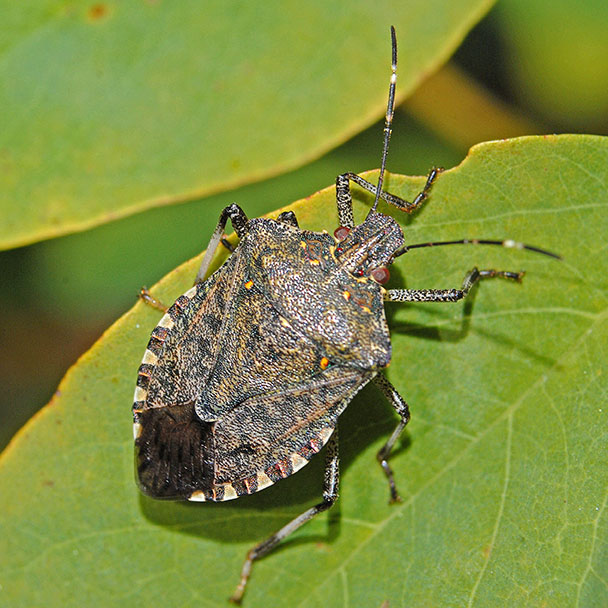
If you grew up not knowing what a stink bug was, congratulations, you are old enough to remember a better time. The brown marmorated stink bug (Halyomorpha halys to its few friends) is a relatively new American annoyance, believed to have hitchhiked over from Asia in a shipping container and first identified in Allentown, Pennsylvania in the late 1990s. It has since spread to more than 40 states. A clean sweep is probably just a matter of time.
The shield-shaped, roughly half-inch bug doesn't bite, sting, spread disease, damage your house, or reproduce indoors. It doesn't even eat anything while it's in your home. What it does is hunker down for the winter in your walls, baseboards, attic, and light fixtures, and then stumble out, confused and buzzing, at inopportune moments. Crush one and you'll learn how it got its name: a pungent, slightly cilantro-adjacent funk that also, unhelpfully, attracts more of them to the same spot.
They sneak in during September and October through the kinds of gaps your house has always had but you never noticed, around window frames, door sweeps, utility pipes, siding seams, and soffits. The best defense is caulk and weather stripping, applied before fall. Once they're inside, the experts are united: don't spray. Indoor pesticides are mostly useless and can attract carpet beetles that feed on the dead bugs. Just vacuum them up (shop vac preferred, since regular vacuums will smell for weeks) and dump them into soapy water.

Rick Good spent ten years in the newspaper business, including with The News & Observer (Raleigh, NC) and The Greenville News (Greenville, SC). He co-wrote, with Melinda Coleman, Rutledge to Riley: Governors of South Carolina, 1776–Present (Published by The Greenville News), and is the author of Mind Games Trivia #1 (Amazon). He has recently spent 15 years creating original trivia content through Sounds Good Mobile Entertainment and continues that with his new company, SGME Software. He edits The Smart Reader’s money, real estate, and business coverage.