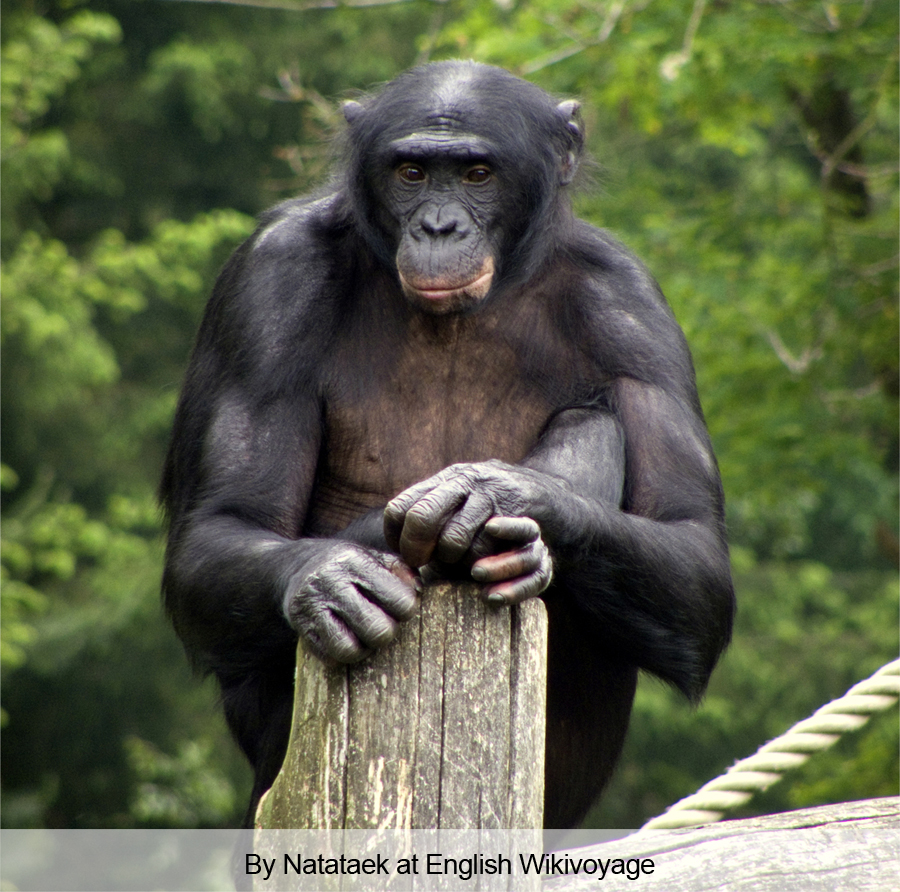
We're unlikely to ever experience a Planet of the Apes-style ape takeover, but if we do, bonobos will probably be the ones to watch out for. That's because bonobos, a close cousin to the chimpanzee (and thus a close cousin to humanity as well) may possess something called "theory of mind," or the ability to understand that others may not know something and react accordingly.
According to Smithsonian Magazine, theory of mind is a key component in many complex human behaviors, and whether it exists in our close relatives has long been a topic of debate among scientists. And finally, two (human) cognitive scientists and three male bonobos decided to put their heads together and try to find an answer.
The scientists designed a cooperative experiment that required the apes to identify where a treat (in this case a grape) was hidden, point to its location, and wait for the researcher to hand it over. Researchers would hide the grape in front of one of the bonobos, bring in another bonobo, and ask the newly arrived ape where the grape was hidden. Not only did the bonobos consistently understand that their partners had no way of knowing where the grape was hidden, they communicated the correct location to ensure that the other ape could still locate (and enjoy) the hidden grape.
The task might sound pretty simple, but the logic behind it — the ability to hold two conflicting views in mind — is the type of sophisticated thinking that has generally only been associated with humans and our capacity for complex language. The experiment also suggests our ancient relatives were able to work cooperatively even before they developed language.

Rick Good spent ten years in the newspaper business, including with The News & Observer (Raleigh, NC) and The Greenville News (Greenville, SC). He co-wrote, with Melinda Coleman, Rutledge to Riley: Governors of South Carolina, 1776–Present (Published by The Greenville News), and is the author of Mind Games Trivia #1 (Amazon). He has recently spent 15 years creating original trivia content through Sounds Good Mobile Entertainment and continues that with his new company, SGME Software. He edits The Smart Reader’s money, real estate, and business coverage.