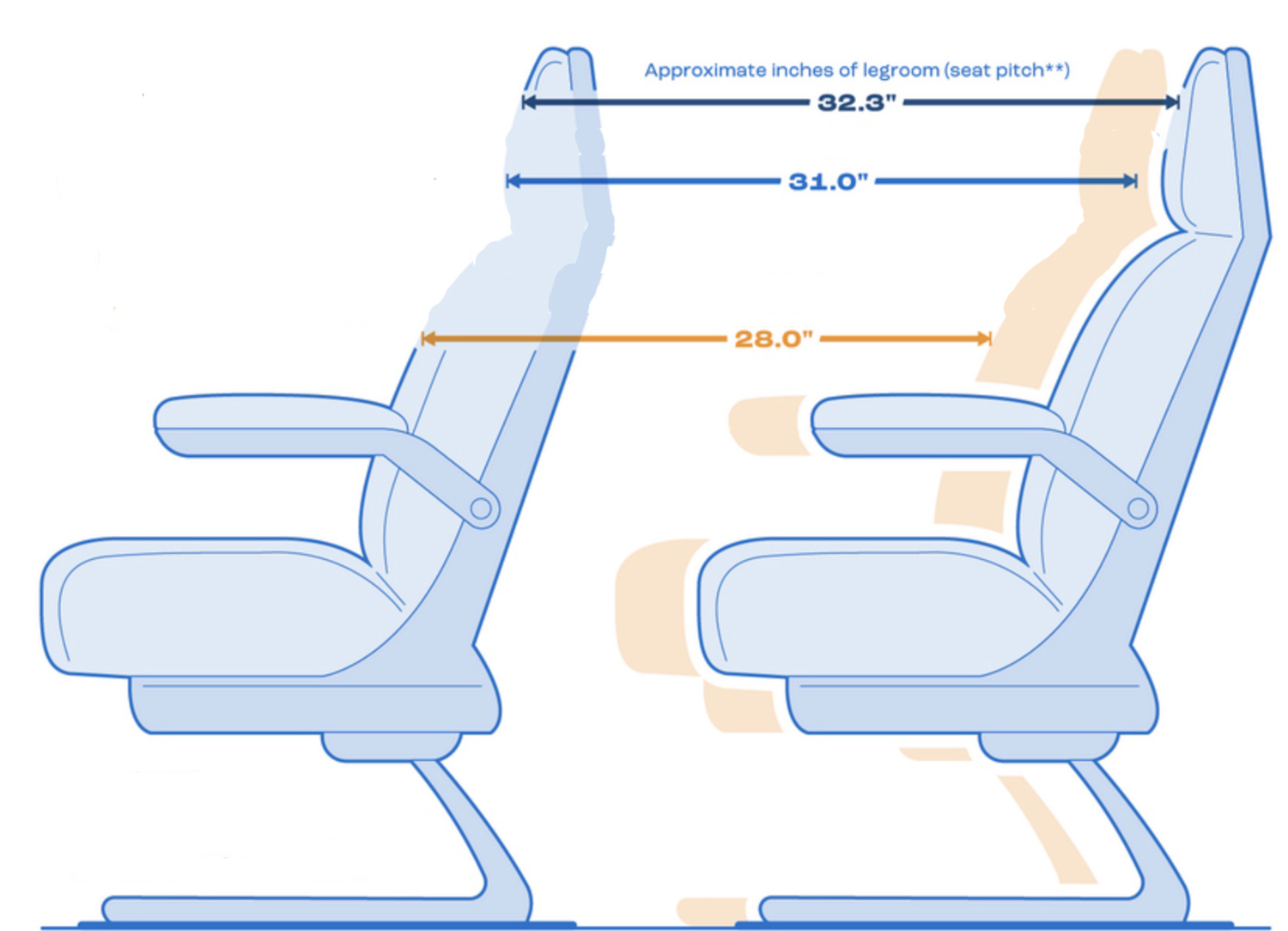
It's become the most important issue in airline travel: Legroom.
Seat pitch is the key measurement that tells you if your legs will be touching your chin when you fly. The more inches of seat pitch you have, the better. Seat pitch is the distance from any point on one seat to the exact same point on the seat in front (or behind).
Taller and the heavier passengers usually need greater seat pitch to be comfortable. In the 1960s, Americans were 24 pounds lighter on average, but they enjoyed a 34-inch seat pitch on most airlines, according to The National Association of Airline Passengers.
Since the 1980s, American, Delta, Southwest and United have all lost at least 2 inches in seat pitch, according to Conde Nast Traveler. The average pitch today is about 31 inches.
The carrier with the greatest seat pitch is JetBlue with 32.3 inches on its Airbus A320 and A321. Southwest Airlines is next with 31.8 inches. Alaska and Delta airlines clock in at 31 inches, with American at 30.2 and United at 30.1, according to Kiplinger.com.
The absolute smallest seat pitch is in budget-conscious Frontier and Spirit airlines, coming in at 28 inches.
Look to the aircraft itself for an idea of legroom.
The best: Embraer 190 at 32 inches. Every other aircraft offers about 31 inches, including Airbus models A350-A330 and Boeing 787, 777 and 767.
Try Seat Guru to review plane layouts.

Rick Good spent ten years in the newspaper business, including with The News & Observer (Raleigh, NC) and The Greenville News (Greenville, SC). He co-wrote, with Melinda Coleman, Rutledge to Riley: Governors of South Carolina, 1776–Present (Published by The Greenville News), and is the author of Mind Games Trivia #1 (Amazon). He has recently spent 15 years creating original trivia content through Sounds Good Mobile Entertainment and continues that with his new company, SGME Software. He edits The Smart Reader’s money, real estate, and business coverage.