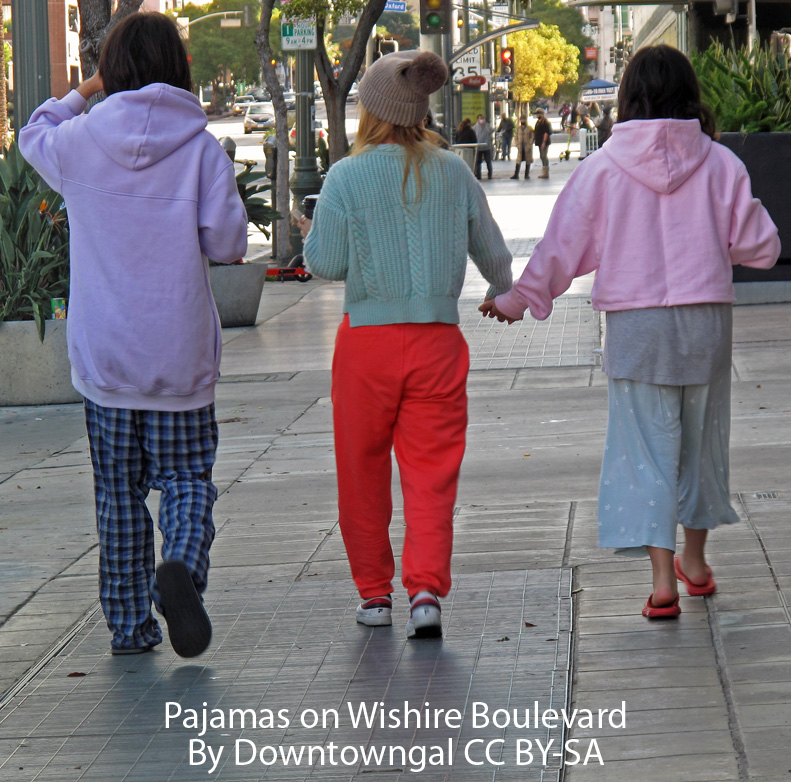
From at least the 1920s, the trend in dressing has gone one way: more casual and comfortable.
According to USA Today, public dressing in the first part of the 20th century was street proper: Men wore jackets and ties and women wore dresses and hats. First Lady Pat Nixon was the first to wear pants at a public function in 1972 and no one blinked by the time Hillary Clinton made it her uniform.
But now it is street casual and unisex: Baseball caps and soft fabrics, even in public spaces.
But pajamas? We've all seen it.
One commentator called it couch couture. While you don't see it a lot, you do see it in the most unlikely places: airplanes, the grocery store and on the street, leaving you to wonder if they could manage to put on the bunny slippers, wouldn't another shoe be just as easy?
There has been both backlash and support for PJs in public.
In 2007, the UAE forbid workers from wearing pajamas to work (that was a problem?). In 2010, a supermarket banned customers from shopping in PJs. In 2012 in Dublin, people seeking welfare services were forbidden from wearing them.
Celebrities since have elevated PJs as street wear, wearing silky pajamas in public — but with heels, naturally, according to Entertainment Tonight.
Men can get away with loung pants, but have to beware of what they might be, um, revealing.
Still, pajamas do look sleepy, which is a short trip to lazy, and remain inappropriate attire for work.

Rick Good spent ten years in the newspaper business, including with The News & Observer (Raleigh, NC) and The Greenville News (Greenville, SC). He co-wrote, with Melinda Coleman, Rutledge to Riley: Governors of South Carolina, 1776–Present (Published by The Greenville News), and is the author of Mind Games Trivia #1 (Amazon). He has recently spent 15 years creating original trivia content through Sounds Good Mobile Entertainment and continues that with his new company, SGME Software. He edits The Smart Reader’s money, real estate, and business coverage.