
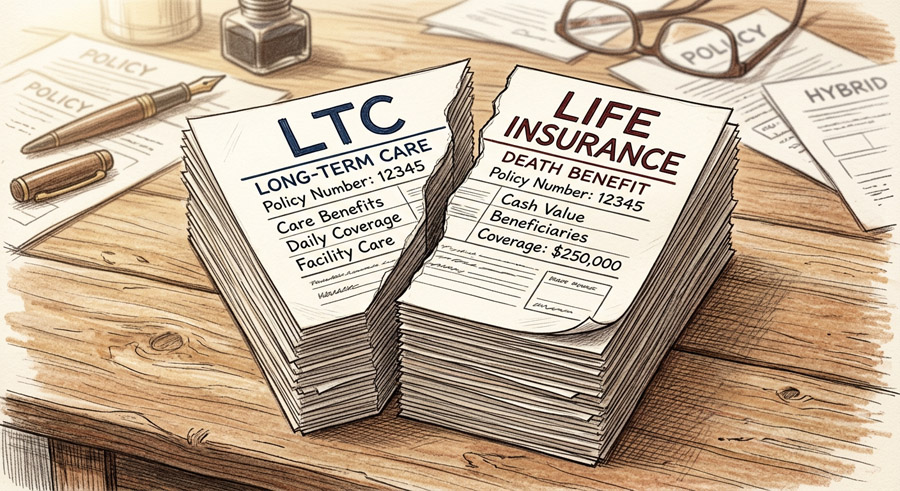
Most people know they should probably think about long-term care insurance. Most people also keep putting it off, in part because of a nagging question: what if I pay into a policy for years and never need it?
It turns out the insurance industry heard that objection. The answer is a product that has quietly become the fastest-growing corner of the long-term care market: the hybrid life insurance and long-term care policy.
The concept is straightforward. You pay premiums into a permanent life insurance policy, either as a lump sum or over a period of years. If you eventually need long-term care, such as home health assistance or a nursing facility, you draw from the policy's value to pay for it. If you never need that care, or don't use the full benefit, your heirs receive whatever remains as a tax-free death benefit.
Either way, the money goes somewhere. That is the core appeal.
Hybrid policies first gained traction around 2010, when traditional stand-alone long-term care insurance was struggling with repeated premium increases and insurers leaving the market. By 2014, hybrid policy sales had surpassed stand-alone policies for the first time, according to the Society of Actuaries. By 2022, more than 900,000 hybrid policies were in force, triple the number from just seven years earlier.
The tradeoff is cost: hybrid policies are more expensive than simple life insurance, and heavy use of long-term care benefits will reduce the death benefit for your heirs.
But for people who have avoided long-term care insurance because it felt like a one-way bet, the hybrid model is worth a conversation with your financial advisor.

Rick Good spent ten years in the newspaper business, including with The News & Observer (Raleigh, NC) and The Greenville News (Greenville, SC). He co-wrote, with Melinda Coleman, Rutledge to Riley: Governors of South Carolina, 1776–Present (Published by The Greenville News), and is the author of Mind Games Trivia #1 (Amazon). He has recently spent 15 years creating original trivia content through Sounds Good Mobile Entertainment and continues that with his new company, SGME Software. He edits The Smart Reader’s money, real estate, and business coverage.