
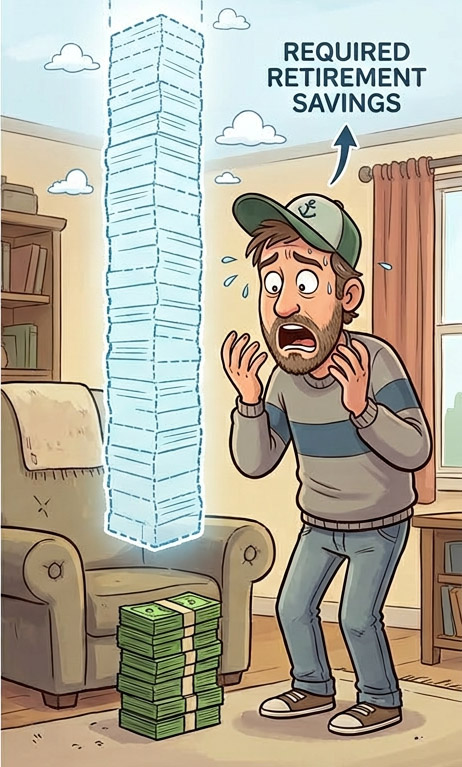
Spend any time reading about retirement and you will encounter some version of the same alarming headline: you need a million dollars. Maybe two million. Possibly more.
Those numbers are real, for some people, in some places. But they are not the universal truth.
Here is what often gets left out of the conversation: The Bureau of Labor Statistics reports that the average household headed by someone 65 or older spends about $5,000 a month. Social Security provides a genuine foundation for that. According to the Social Security Administration, the average monthly retirement benefit in early 2026 is about $2,076. For a couple in which both partners receive benefits, that can mean $4,000 or more every month before touching savings.
The other factor the scary headlines routinely ignore is geography. Where you choose to live may be your single most powerful financial decision. Researchers at Boston College's Center for Retirement Research have found that retirement costs vary dramatically by location. Money stretches significantly further in states like Indiana, Iowa, Oklahoma, and Minnesota than in high-cost coastal cities. The retirement math that produces a million-dollar requirement in San Francisco or New York simply does not apply in most of the country.
There is one genuine wild card: catastrophic medical expenses can upend even a solid plan. Medicare covers much, but not everything. Supplemental coverage, sometimes called Medigap, can fill some of those gaps, though premiums tend to rise with age and can become a significant expense in their own right. Long-term care insurance, which covers nursing home or in-home care costs that Medicare does not, is a conversation worth having with a financial advisor before you need it. By age 75, it is probably too late.
The bottom line is that the right number for retirement is personal, local, and almost certainly less frightening than the headlines suggest. A conversation with a financial advisor about your specific situation, where you live, what Social Security will provide, and what you actually spend, is worth far more than any national average.

Rick Good spent ten years in the newspaper business, including with The News & Observer (Raleigh, NC) and The Greenville News (Greenville, SC). He co-wrote, with Melinda Coleman, Rutledge to Riley: Governors of South Carolina, 1776–Present (Published by The Greenville News), and is the author of Mind Games Trivia #1 (Amazon). He has recently spent 15 years creating original trivia content through Sounds Good Mobile Entertainment and continues that with his new company, SGME Software. He edits The Smart Reader’s money, real estate, and business coverage.