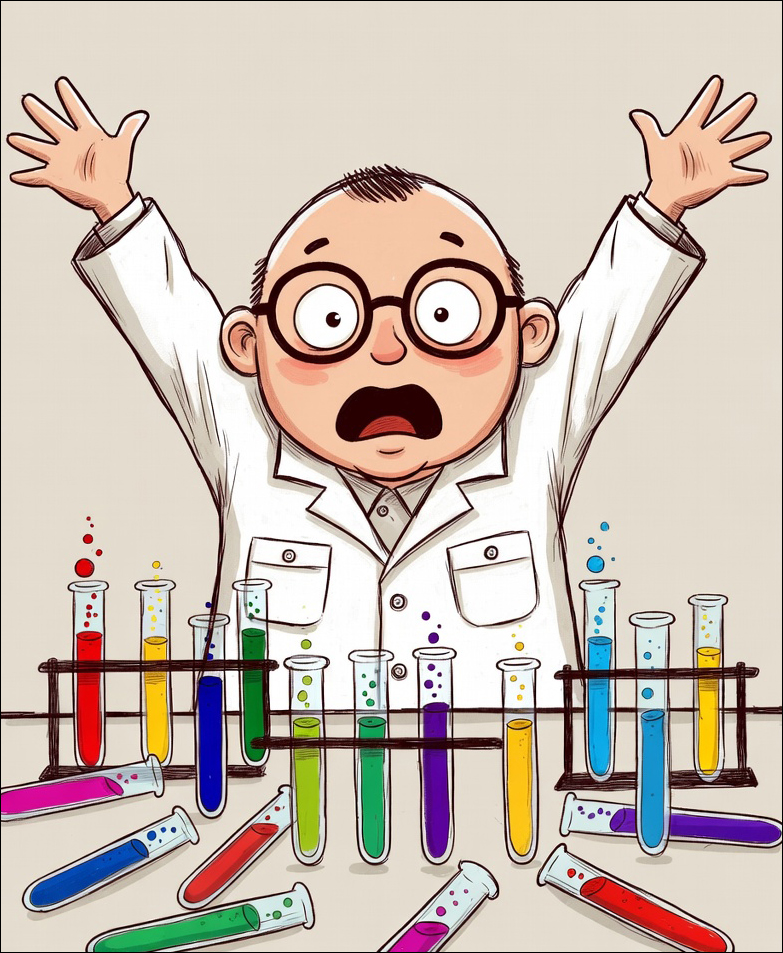
Researchers at Oregon Health & Science University may have accidentally engineered a cancer treatment breakthrough. The team originally aimed to create a safer version of a toxic compound with known anticancer properties, but hit the jackpot when their experiment failed to perform as expected. Instead, they created a molecule that attacks cancer cells through a completely different mechanism, and their experimental compound could eventually become a new cancer drug.
But the Oregon researchers are hardly the first scientists to benefit from sheer dumb luck. Some of the most famous dumb luck discoveries have revolutionized medicine, changed the way we interact with the world, and created objects that we take for granted in our daily lives.
Thomas Edision had no intention of inventing the phonograph during the summer of 1877. His experiments with tinfoil and paper cylinders were actually intended to record telegraph signals. Instead, he accidentally recorded his own voice, a dumb luck discovery that eventually became the phonograph.
Several cultures have used mold in traditional medicine throughout history, but no one really understood the details until English bacteriologist Alexander Fleming came back from vacation in 1928. While sorting through petri dishes of harmful bacteria after his return, he noticed that the area around a blob of mold was completely clear of bacteria colonies. The rare strain of mold, called Penicillium notatum, was secreting something miraculous — penicillin.
Nitroglycerin was incredibly useful as an explosive during the 19th century, but so unstable that vials were prone to blow up without warning. The Swedish chemist Alfred Nobel was cautiously tinkering with ways to make it safer when he accidentally dropped a vial on sawdust-covered ground. Nobel was surprised to find himself alive an unharmed, and realized that the sawdust had stabilized the nitroglycerin enough to save his skin. After some additional refinement, Nobel introduced dynamite to the world.
Robert Chesebrough couldn't hack it as an oilman, but he still struck gold in the oil fields in 1859. Workers constantly complained about a substance called, rod wax' that clogged their drilling equipment, and Chesebrough was intrigued. He returned to his New York laboratory with a sample of the viscous yellow substance and discovered that the isolated version was pretty good at protecting cuts and scrapes. He named his discovery Vaseline, and we've been smearing it on ourselves ever since.
Sources: Gizmodo, American Council on Science and Health

Rick Good spent ten years in the newspaper business, including with The News & Observer (Raleigh, NC) and The Greenville News (Greenville, SC). He co-wrote, with Melinda Coleman, Rutledge to Riley: Governors of South Carolina, 1776–Present (Published by The Greenville News), and is the author of Mind Games Trivia #1 (Amazon). He has recently spent 15 years creating original trivia content through Sounds Good Mobile Entertainment and continues that with his new company, SGME Software. He edits The Smart Reader’s money, real estate, and business coverage.