Author and editor Philip Van Doren Stern came up with the idea one morning in 1938 while shaving. An eccentric stranger appears out of nowhere to save a despairing man from suicide on Christmas Eve and help him understand how much others love and value him.
Stern sporadically worked on the story for years, but didn't show it to his agent until 1943. Unfortunately, the story didn't sell, but Stern still liked it so much that he paid to have 200 copies printed as a pamphlet called The Greatest Gift: A Christmas Tale. Most of the pamphlets went to friends and family as a holiday card, but Stern wisely sent two to the U.S. Copyright Office at the Library of Congress.
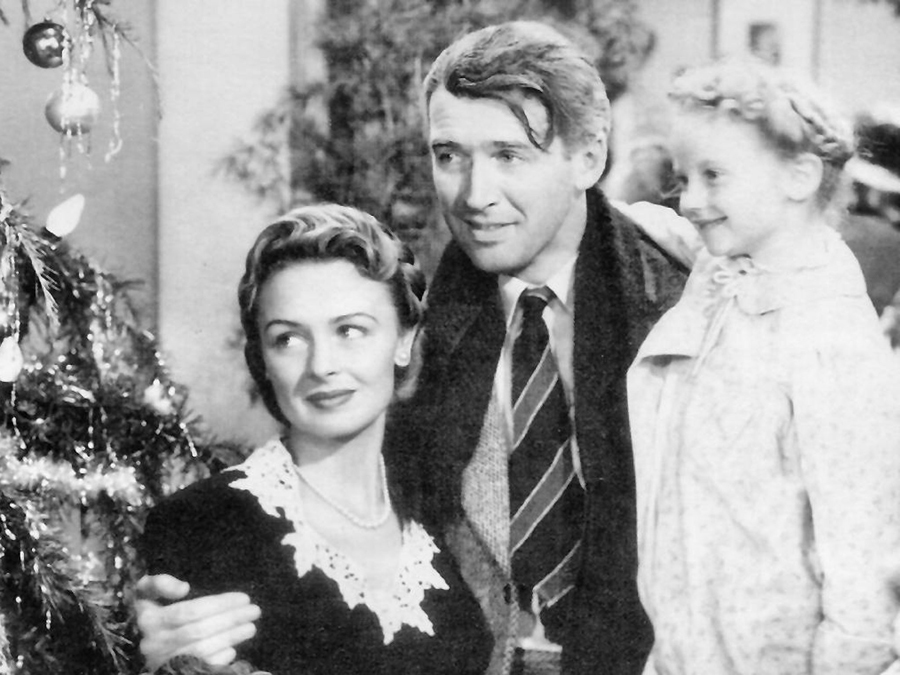
The following year, RKO Radio Pictures stumbled upon the pamphlet and purchased the film rights for $10,000, and two magazines and a book had reproduced the short story for larger audiences to read by 1945. But despite its newfound commercial appeal, RKO shelved its own version of the film and re-sold the rights to Liberty Films, Frank Capra's newly-formed production company. Capra helped write a new script, cast Jimmy Stewart as the lead, and It's a Wonderful Life finally hit the silver screen on Dec. 20, 1946.
Just over two hours long, the film follows the humble and hard-working George Bailey's life and the mysterious angel Clarence Odbody as he tries to earn his wings. When a crisis hits and George wishes that he had never been born, Clarence grants his wish, and George realizes that his modest life in Bedford Falls matters more than he ever imagined. At the conclusion of the film, George's many friends arrive to support him in his time of need and a bell rings to signify that Clarence finally earned his wings.
Critics had mixed opinions about the film, with some scorning the sentimental tone and setting while others appreciated the warmth and humor. It's a Wonderful Life was nominated for five Academy Awards, but collected no trophies and ultimately lost money. Over the following decades, ownership rights continually changed hands, and the copyright lapsed in 1974 after National Telefilm Associates neglected to renew it. Without costly royalties to pay, television broadcasters aired the film repeatedly during each holiday season, transforming it from a moribund flop into a nostalgia-laden holiday classic.
It's a Wonderful Life still has its critics. They call it sappy, overly long, smug, and simplistic. But as the late Roger Ebert noted, "Even the corniest scenes in the movie — those galaxies that wink while the heavens consult on George's fate — work because they are so disarmingly simple."
That celebration of the simple and honest and humble might well be the engine that powers the whole movie, and the thing that chokes millions of people up during each annual viewing. Life can be challenging, and It's a Wonderful Life reliably reminds us that even during our darkest times, no man is a failure who has friends.

Rick Good spent ten years in the newspaper business, including with The News & Observer (Raleigh, NC) and The Greenville News (Greenville, SC). He co-wrote, with Melinda Coleman, Rutledge to Riley: Governors of South Carolina, 1776–Present (Published by The Greenville News), and is the author of Mind Games Trivia #1 (Amazon). He has recently spent 15 years creating original trivia content through Sounds Good Mobile Entertainment and continues that with his new company, SGME Software. He edits The Smart Reader’s money, real estate, and business coverage.