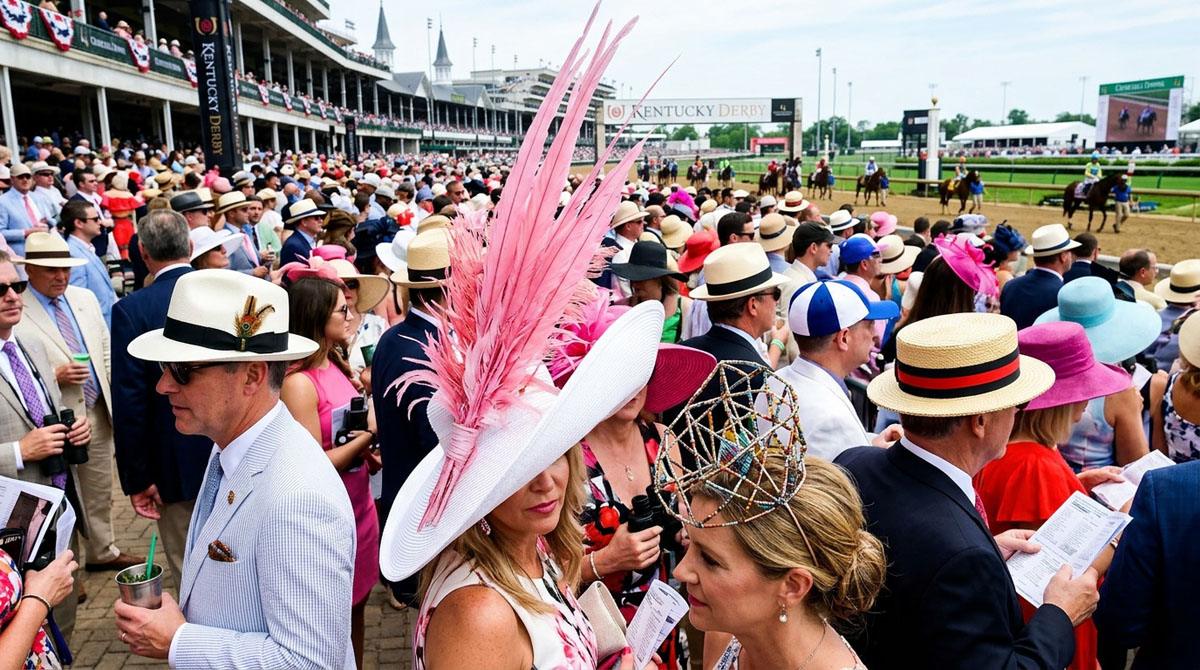
Once upon a time, a woman wore a hat to the Kentucky Derby for the same reason she wore one anywhere in polite society: because that's what dignified women did. Simple, tidy, forgettable. A hat was punctuation, not a sentence.
Somewhere along the way, the punctuation became a paragraph. Then a novel.
By the late 20th century, Derby hats had evolved into full-blown theatrical events, cascading wide brims threatening nearby guests, fresh flowers tumbling over the edges, feathers reaching toward the Churchill Downs sky. Milliners began treating Derby commissions like gallery pieces. Attendees began planning their hats months in advance. The hat stopped saying "I am respectable" and started saying "I am here."
Meanwhile the men increasingly get into the act with a jaunty straw hat, white trilby, or fedora — set off by feathers and colorful bands.
Every year the Louisville Courier Journal, writes about the fashion explosion, picturing the hats that amazed them, sweeping brims with yards of silk organza set off by flowers. And the hats that made them laugh: You will see a horse on a hat or a hat that's a horse.
Across the Atlantic, the British took a different path. At Royal Ascot, where hats are literally required by dress code, the favored style is the fascinator, small, sculptural, and perched just so. Where the Derby went big and brimmed, the British went architectural and precise. Men must wear a gray or back top hat, a symbol of distinction and class and a morning suit is required.
Same love of spectacle, different aesthetic entirely.

Rick Good spent ten years in the newspaper business, including with The News & Observer (Raleigh, NC) and The Greenville News (Greenville, SC). He co-wrote, with Melinda Coleman, Rutledge to Riley: Governors of South Carolina, 1776–Present (Published by The Greenville News), and is the author of Mind Games Trivia #1 (Amazon). He has recently spent 15 years creating original trivia content through Sounds Good Mobile Entertainment and continues that with his new company, SGME Software. He edits The Smart Reader’s money, real estate, and business coverage.