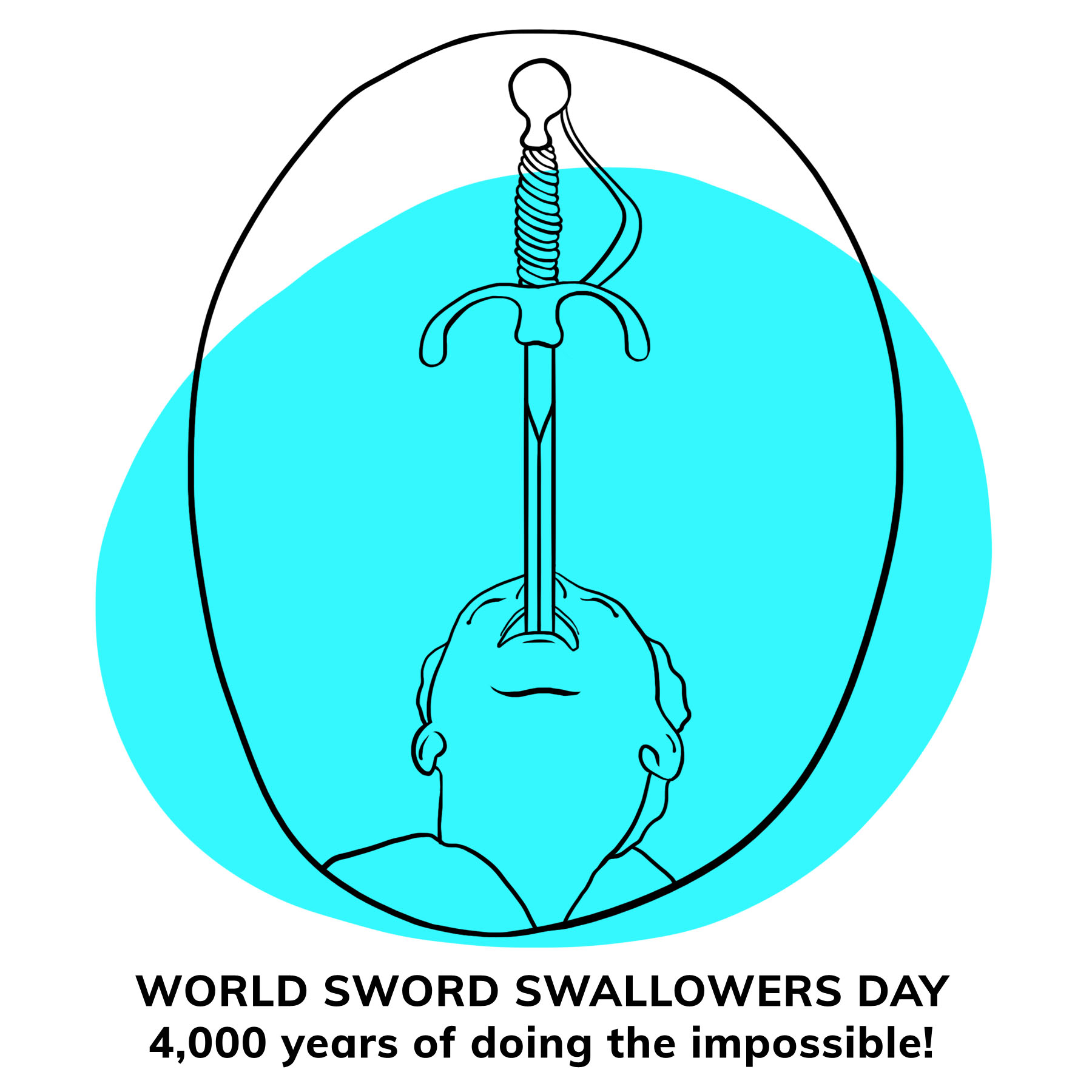
It is an ancient art. Even an ancient religious art. The kind of art that makes you say Ewwww.
Sword Swallowing is not for those with tender hearts, or weak stomachs. It isn't done with mirrors. They actually swallow the sword.
According to Sword Swallowers Association International (SSAI), the practice was probably started in 2000 BC when the Fakirs of India swallowed swords to demonstrate their invulnerability, thanks to the gods. The Greeks and Romans took up the practice by 1 AD. With that, it spread throughout Asia and Europe.
Today, if you can see the ancient art, it will probably be in connection with Ripley's Believe It Or Not (naturally) on World Sword Swallowers Day, the last Saturday in February. This event is helpfully held in connection with National Swallowing Disorders Month.
So, you might well ask: Is it a trick? According to SSAI, no. They don't use a fake or trick sword. They don't swallow a tube first to protect their throat, which would be worse, they say.
Sword swallowers need to completely eliminate the gag reflex. They must also learn to voluntarily relax muscles in the throat and esophagus. These muscles usually are not voluntary. They have to hyperextend to form a straight line between the pharnyx and stomach.
It is dangerous, but probably less than one might imagine. For one thing, the art requires physical skills that take years to master.
In 2006, the British Medical Journal did a study of injuries associated with sword swallowing. The journal concluded that sword swallowing was most dangerous when the swallower was distracted. Seems fair. Punctures and hemorrhage were the main problems, but the journal could not find anyone who died from sword swallowing.
Amateurs, presumably those who decide one day to stick a sword down their throat, are at the highest risk.

Rick Good spent ten years in the newspaper business, including with The News & Observer (Raleigh, NC) and The Greenville News (Greenville, SC). He co-wrote, with Melinda Coleman, Rutledge to Riley: Governors of South Carolina, 1776–Present (Published by The Greenville News), and is the author of Mind Games Trivia #1 (Amazon). He has recently spent 15 years creating original trivia content through Sounds Good Mobile Entertainment and continues that with his new company, SGME Software. He edits The Smart Reader’s money, real estate, and business coverage.