
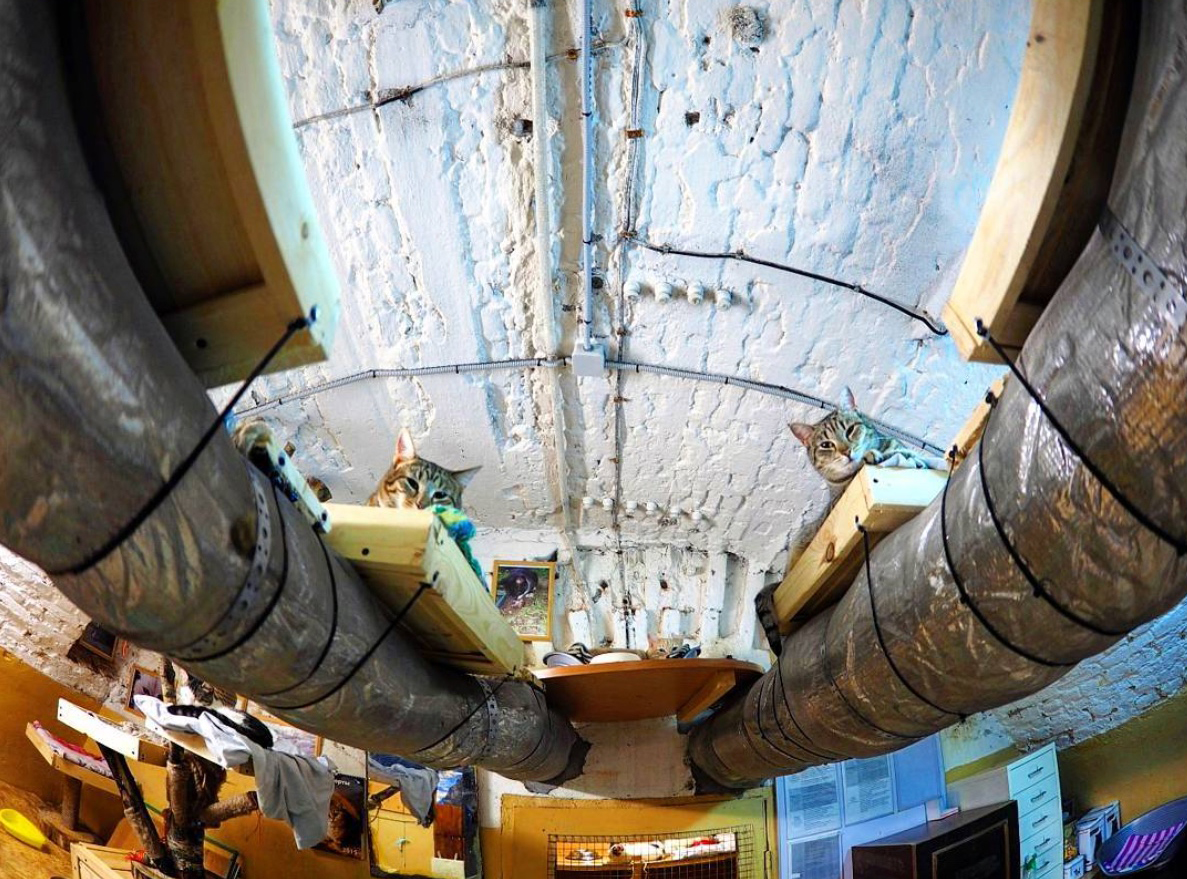
You have your school of fish and mob of kangaroos, but you mostly find a proper clowder of cats in places where humans put up a fight against mice and rats.
Today, the most famous clowder may be in the largest museum in the world, the Hermitage in St. Petersburg, Russia, founded by Empress Catherine the Great in 1764.
The clowder was formed earlier, in 1745, when the Hermitage was merely a palace with a mouse problem. Empress Elizabeth Petrovna ordered 30 cats. Those cats and their descendants roamed the galleries and cellars, controlling rodents for nearly 200 years.
But the cats couldn't survive the Nazi's siege of Leningrad (now St. Petersburg) that began in 1941. During the brutal 900-day siege, the city was intentionally starved. By the end of the siege in January 1944, there were no more cats. The rats, however, survived.
Rats were destroying the Hermitage. Although some treasures had been evacuated, everything else was at risk.
According to Russian Beyond, residents of Siberian cities sent 5,000 cats known for their mousing skills. The cats quickly took care of the problem.
Today the 70-cat clowder lives in the cellars of the Hermitage, no longer allowed to roam the galleries. But don't feel too sorry for them. There are about 13 miles of cellars, plus courtyards and tunnels where the cats are the new czars. They no longer work for a living. They lounge around on warm heat conduits or in baskets and boxes made for them. Their staff prepares their food in the cat kitchens. They have a cat hospital. They even have their own press secretary and Instagram account.

Rick Good spent ten years in the newspaper business, including with The News & Observer (Raleigh, NC) and The Greenville News (Greenville, SC). He co-wrote, with Melinda Coleman, Rutledge to Riley: Governors of South Carolina, 1776–Present (Published by The Greenville News), and is the author of Mind Games Trivia #1 (Amazon). He has recently spent 15 years creating original trivia content through Sounds Good Mobile Entertainment and continues that with his new company, SGME Software. He edits The Smart Reader’s money, real estate, and business coverage.