
Navajo wasn't the only Native language used for code talk
During World Wars I and II, Native American code talkers used their unwritten, complex languages to transmit messages that enemy forces, particularly German and Japanese intelligence, could not decipher.
Among these, the more than 300 Navajo Code Talkers, celebrated each year on August 14, are the most famous, but they weren't the only Native American code talkers:
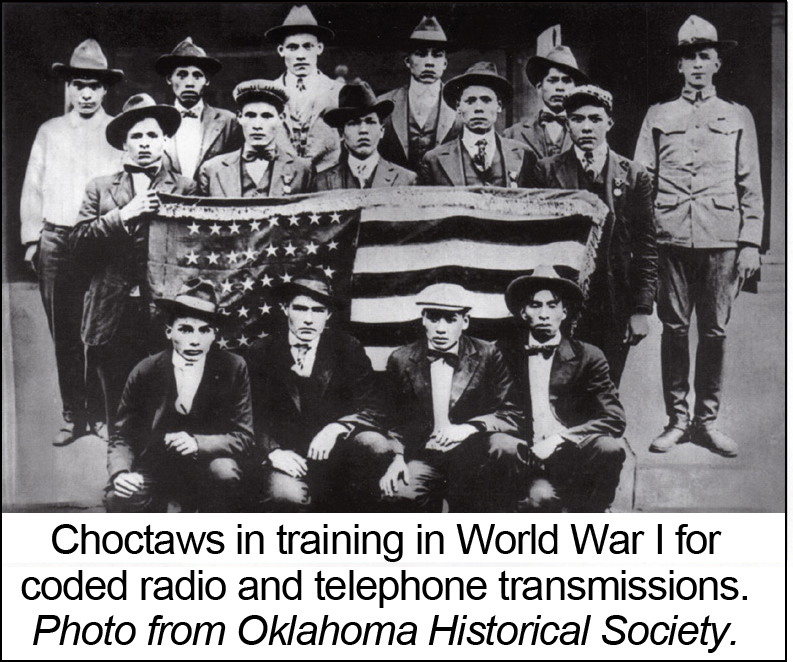
The Choctaw, World War I. The Choctaw were the first documented Native American code talkers in World War I (1917'1918). The German army had cracked U.S. codes and tapped telephone lines, so eight Choctaw soldiers in Company E, 142nd Infantry, were assigned to transmit messages in their language during the Meuse-Argonne Offensive (October 1918), a critical campaign. In 1989, the French government awarded the Choctaw Nation the Chevalier de l'Ordre National du Merite for their role. In 2013, the U.S. Congress awarded Congressional Gold Medals to code talkers from 33 tribes, including the Choctaw, recognizing their World War I service.
The Comanche, World War II. Recruited in 1941, the Comanche served as code talkers in the U.S. Army's 4th Infantry Division. The Comanche developed a code with about 250 terms, combining direct translations and coined phrases. For example, "tukomoo" (black) denoted a tank, and "wakaree" (turtle) meant a tank destroyer.
The Hopi (World War II). About 11 Hopi code talkers served in the Pacific, Philippines, and New Guinea. Their language's unique phonology and grammar made it indecipherable to enemies, but because there were so few speakers, the program couldn't be expanded.
The Meskwaki (World War II). The Iowa Sac and Fox Nation provided eight soldiers during World War II, representing 7 percent of the tribe's male population. They made significant contributions in North Africa.
Less well-documented are the World War II contributions of the Cherkoee, Lakota and Dakota (Sioux), Creek (Muscogee), Chippewa (Ojibwe), Kiowa, Pawnee, and Seminole.

Rick Good spent ten years in the newspaper business, including with The News & Observer (Raleigh, NC) and The Greenville News (Greenville, SC). He co-wrote, with Melinda Coleman, Rutledge to Riley: Governors of South Carolina, 1776–Present (Published by The Greenville News), and is the author of Mind Games Trivia #1 (Amazon). He has recently spent 15 years creating original trivia content through Sounds Good Mobile Entertainment and continues that with his new company, SGME Software. He edits The Smart Reader’s money, real estate, and business coverage.