

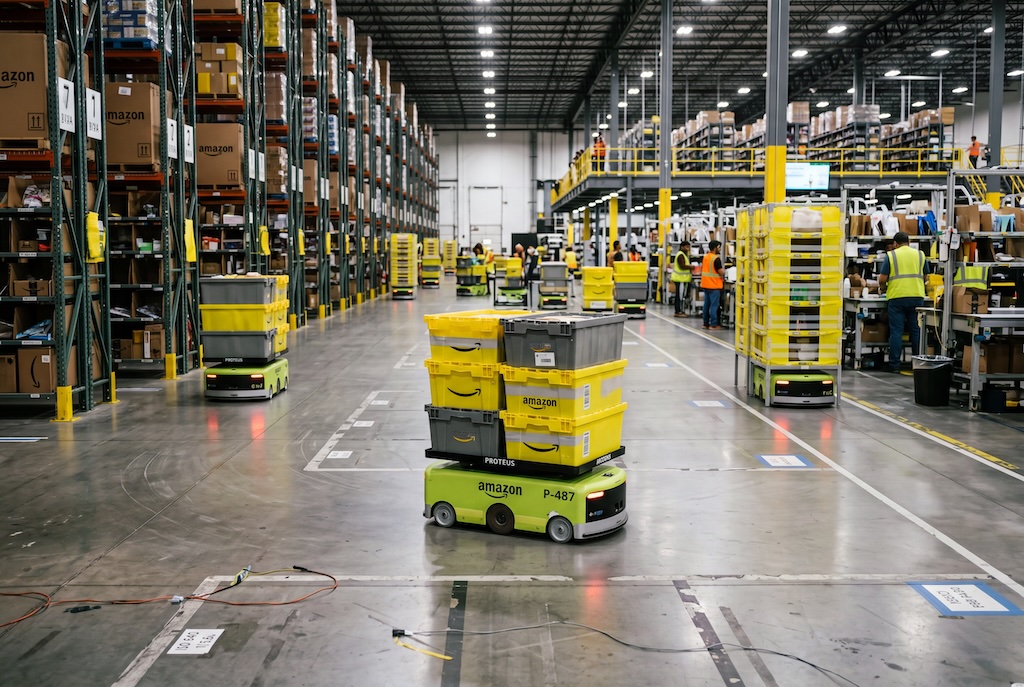
Until recently, putting a warehouse robot to work meant programming it through special software. Amazon's newest machine simply needs to be told what to do in plain English.
At a London event in June, according to Amazon, the company unveiled a new version of its Proteus robot, a wheeled unit that hauls heavy carts. A worker now tells it what to move and where, and the robot works out the priority, the route, and the timing itself. One Amazon executive called it an assistant for moving material. The ability is not Amazon's alone; teaching machines to follow everyday commands is a broad push across the robotics industry.
The appeal is easy. Skip the programming and almost any worker can direct a robot, while a single flexible machine can absorb tasks that once took several people or custom code.
It cuts both ways. According to the New York Times, internal Amazon documents indicate the company could avoid hiring more than 160,000 U.S. workers it would otherwise need by 2027, and more than 600,000 by 2033, even while expecting to sell twice as much. The stated goal is to automate about three-quarters of operations. Amazon called the documents incomplete and said they reflect one team's view, not company strategy.
Alongside a 10-billion-euro expansion in Europe, according to Amazon, the company plans to add 25,000 jobs there, and says tomorrow's roles will involve tending the robots rather than keeping pace with them.

Briefs and quick reads selected and edited by The Smart Reader’s editorial team.