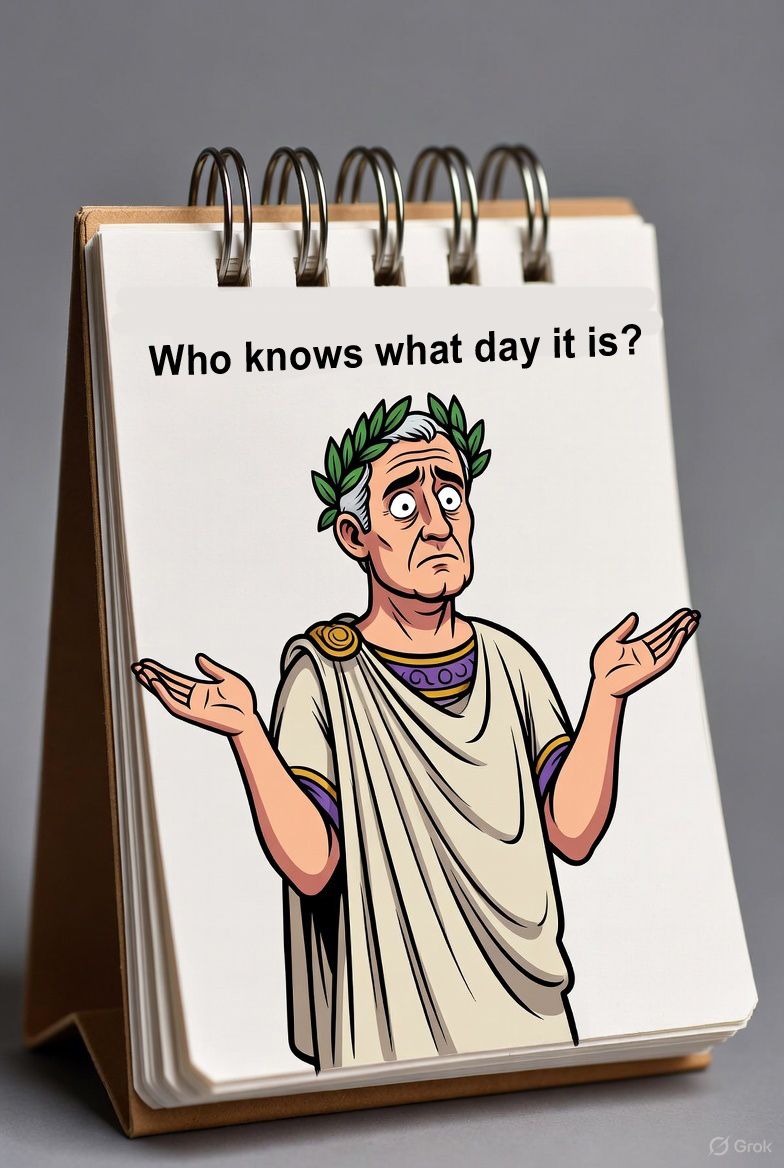
The Romans did nothing during January because January didn't exist.
According to the BBC, the early Roman calendar contained only 304 days and ten months. After the month we now call December ended, Romans just…stopped counting for two months before resuming for March, the first month of the new year.
In the 8th century BC, King Numa Pompilius decided that something had to be done about this ridiculous methodology, and added two new months — what we now call January and February — to the calendar, totaling 51 days. The new 355-day calendar corresponded to the 354-day lunar calendar, with an extra day tacked on for good measure, since the Romans were superstitious about even numbers.
But within a few years, the new calendar proved that it didn't play well with the solar calendar and the passing of the seasons. Months didn't stay fixed to seasons, and the calendar was generally useless. Roman priests came up with a solution — a new month called Mercedonius that could be used on an as-needed basis to keep the calendar on track with the seasons. But Mercedonius instead became an unlikely tool of political corruption, inserted for the convenience of public officials instead of calendar consistency.
To shove the calendar back into synch with the sun, Julius Caesar added two extra months to the year 46 B.C — a year that officially lasted 445 days. The next year, the two extra months and Mercedonius were both scrapped. The new 12-month calendar was workable, but flawed — a flaw that the Emperor Augustus addressed a few decades later with the introduction of the leap year.
January may be cold and gray where you live, but don't let it get you down, because at least you know for sure that it's January and not Mercedonius.

Rick Good spent ten years in the newspaper business, including with The News & Observer (Raleigh, NC) and The Greenville News (Greenville, SC). He co-wrote, with Melinda Coleman, Rutledge to Riley: Governors of South Carolina, 1776–Present (Published by The Greenville News), and is the author of Mind Games Trivia #1 (Amazon). He has recently spent 15 years creating original trivia content through Sounds Good Mobile Entertainment and continues that with his new company, SGME Software. He edits The Smart Reader’s money, real estate, and business coverage.