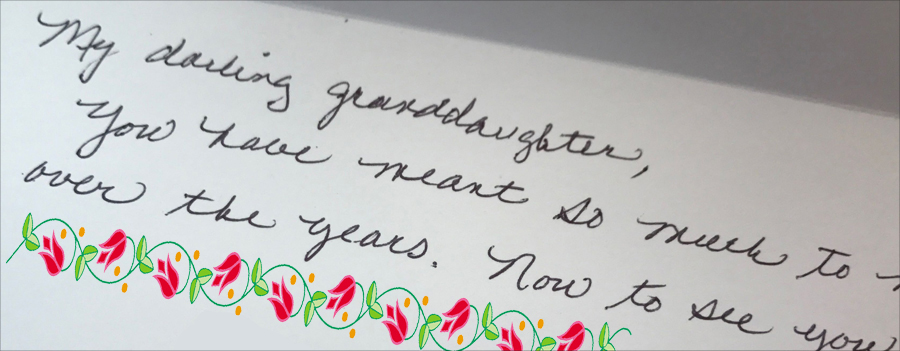
Generation after generation, young school-aged children labored over cursive handwriting workbooks, tracing over unfamiliar letters and joining those letters together in wobbly practice sentences. The letters 'a' and 'u' were easy, but others, like the uppercase 'S', may as well have been a different alphabet entirely. Not all of those children grew into adults with lovely penmanship, but at least they could read cursive handwriting.
These days, cursive instruction is off the table in many states, teachers use precious class time to prepare their students for all-important standardized tests. As a result, many American students and young adults never learn to write — or sometimes even read — in cursive.
Harvard history professor Drew Gilpin Faust was shocked to find that two-thirds of the undergraduate students in one of her classes couldn't read cursive. In an interview with NPR, Faust expressed concern that younger Americans would be unable to read handwritten historical documents or papers with information about their family histories.
Fortunately, cursive seems to be making a comeback. In 2016, just 14 states required schools to teach cursive writing, but 22 states (and counting) mandated it by the end of 2023.
For kids and young adults who want to learn cursive (or older folks who want to brush up), those old-fashioned cursive workbooks are still easy to find at bookstores or online retailers like Amazon. Mobile apps like Writey can also provide instruction in everything from basic cursive to calligraphy.

Rick Good spent ten years in the newspaper business, including with The News & Observer (Raleigh, NC) and The Greenville News (Greenville, SC). He co-wrote, with Melinda Coleman, Rutledge to Riley: Governors of South Carolina, 1776–Present (Published by The Greenville News), and is the author of Mind Games Trivia #1 (Amazon). He has recently spent 15 years creating original trivia content through Sounds Good Mobile Entertainment and continues that with his new company, SGME Software. He edits The Smart Reader’s money, real estate, and business coverage.