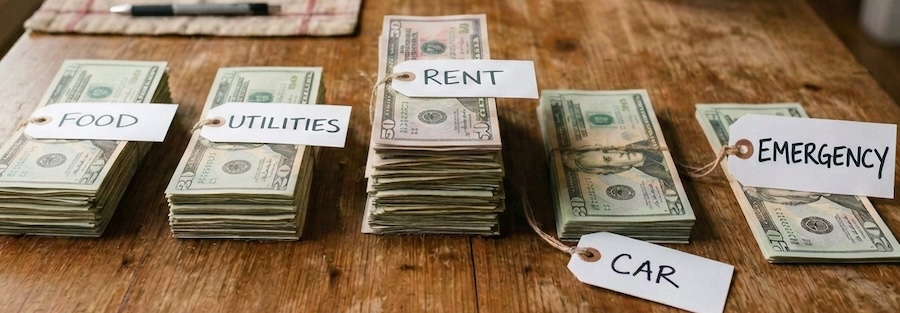
The most repeated advice in personal finance is also the most discouraging: keep three to six months of expenses in the bank. For some, it is useless advice because it would take years to build up six months expense money, and it may not even be possible.
The numbers bear that out. According to Bankrate’s 2026 Emergency Savings Report, only 47 percent of Americans could cover a surprise $1,000 expense from savings, and nearly one in four has nothing set aside at all. Telling that household to bank half a year’s pay is an invitation to give up before starting.
A smaller target works better: one month of bare-bones expenses, or even a first $500. A growing number of financial planners now favor starting that small, according to 24/7 Wall St., because a modest cushion already keeps the most common emergencies from turning into catastrophes.
What makes a cushion work is margin, the room between what you earn and what you have promised to spend. A household with low fixed costs and $1,000 saved survives a setback better than one with $8,000 saved and payments on everything.
The single discipline that protects that margin is staying off the credit card. A balance at the rates above 20 percent that Bankrate tracks turns one emergency into a permanent one. No savings account earns that back.
A more reasonable goal for an emergency fund: small enough to reach; big enough to matter.

Rick Good spent ten years in the newspaper business, including with The News & Observer (Raleigh, NC) and The Greenville News (Greenville, SC). He co-wrote, with Melinda Coleman, Rutledge to Riley: Governors of South Carolina, 1776–Present (Published by The Greenville News), and is the author of Mind Games Trivia #1 (Amazon). He has recently spent 15 years creating original trivia content through Sounds Good Mobile Entertainment and continues that with his new company, SGME Software. He edits The Smart Reader’s money, real estate, and business coverage.