
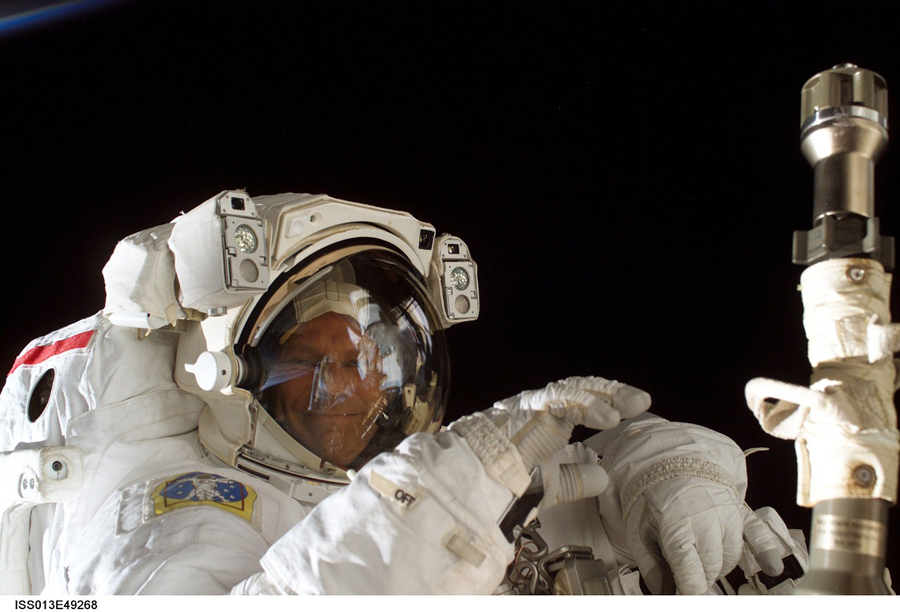
In the future, cancer treatment might come from outer space. Seriously.
Immunotherapy drugs, which throw the body's immune system into overdrive so it can target and destroy cancer cells, are already transforming how certain advanced cancers are treated, according to the Cancer Research Institute. But, like conventional chemotherapy, patients on immunotherapy drugs must receive each dose intravenously in a clinical setting, which can take hours. And thanks to their chemical properties, there are no alternative formulations that can be administered at home, either — at high concentrations, the drugs are too thick and viscous to inject with a regular syringe.
The biotechnology startup BioOrbit hopes to change that — they just need a flight to space first.
According to Wired, crystallizing the proteins in immunotherapy drugs would make them injectable, but Earth's gravitational pull makes that nearly impossible to do correctly. BioOrbit's founder Katie King, who holds a PhD in nanomedicine from Cambridge, has a solution: Make the drugs in space instead.
It's not a pie in the sky (or space) idea — in fact, BioOrbit has already secured funding to test the process on the International Space Station in 2024. If the test proves successful, they hope to conduct a second flight with a pharmaceutical partner. And they may have an easy time finding one, since pharmaceutical giants like Bristol Myers Squibb and Merck have already been conducting research in space for years.
Katie King's goal is to have a permanent facility in space to conduct research and manufacture drugs that she hopes will revolutionize an already-revolutionary field of research. And maybe it's not such a crazy idea after all.

Briefs and quick reads selected and edited by The Smart Reader’s editorial team.