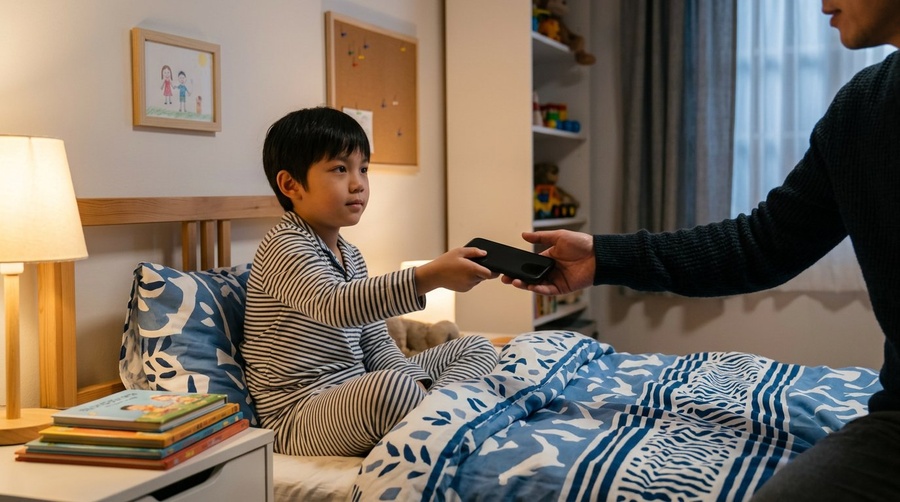
The phone is already in the child's hand. Now what?
For most parents and grandparents today, the question is not whether young children will have devices, it is how to keep the devices from running the household. The American Academy of Pediatrics and pediatric experts at Mayo Clinic, Children's Hospital Los Angeles, and Phoenix Children's Hospital all agree on a few practical rules that work better than a stopwatch.
Screen-free zones. According to Mayo Clinic, the simplest, most effective rule is geography. Designate certain places where devices do not go, the dinner table, the bathroom, the bedroom at night. Children quickly accept rules tied to a place rather than rules tied to a clock.
Screen-free times. According to the American Academy of Child and Adolescent Psychiatry, the hour before bedtime should be device-free. Screen light disrupts sleep, and overstimulated children take much longer to settle.
Earn it first. Several pediatricians recommend tying device time to a short list of daily must-dos: brushing teeth, finishing homework, reading for 20 minutes, helping with a chore. The list does not need to be long. The point is that the device becomes the reward for the day, not the default.
Charge the device elsewhere. According to Mayo Clinic, the single most effective rule for school-age children is requiring devices to charge in a parent's room overnight. It eliminates the late-night scrolling problem entirely.
Watch the adult example. According to Children's Hospital Los Angeles, the doctor's first question is often whether the adults in the household have healthy screen habits.
The goal is not to eliminate screens. It is to make sure the child runs the device, not the other way around.

Rick Good spent ten years in the newspaper business, including with The News & Observer (Raleigh, NC) and The Greenville News (Greenville, SC). He co-wrote, with Melinda Coleman, Rutledge to Riley: Governors of South Carolina, 1776–Present (Published by The Greenville News), and is the author of Mind Games Trivia #1 (Amazon). He has recently spent 15 years creating original trivia content through Sounds Good Mobile Entertainment and continues that with his new company, SGME Software. He edits The Smart Reader’s money, real estate, and business coverage.