

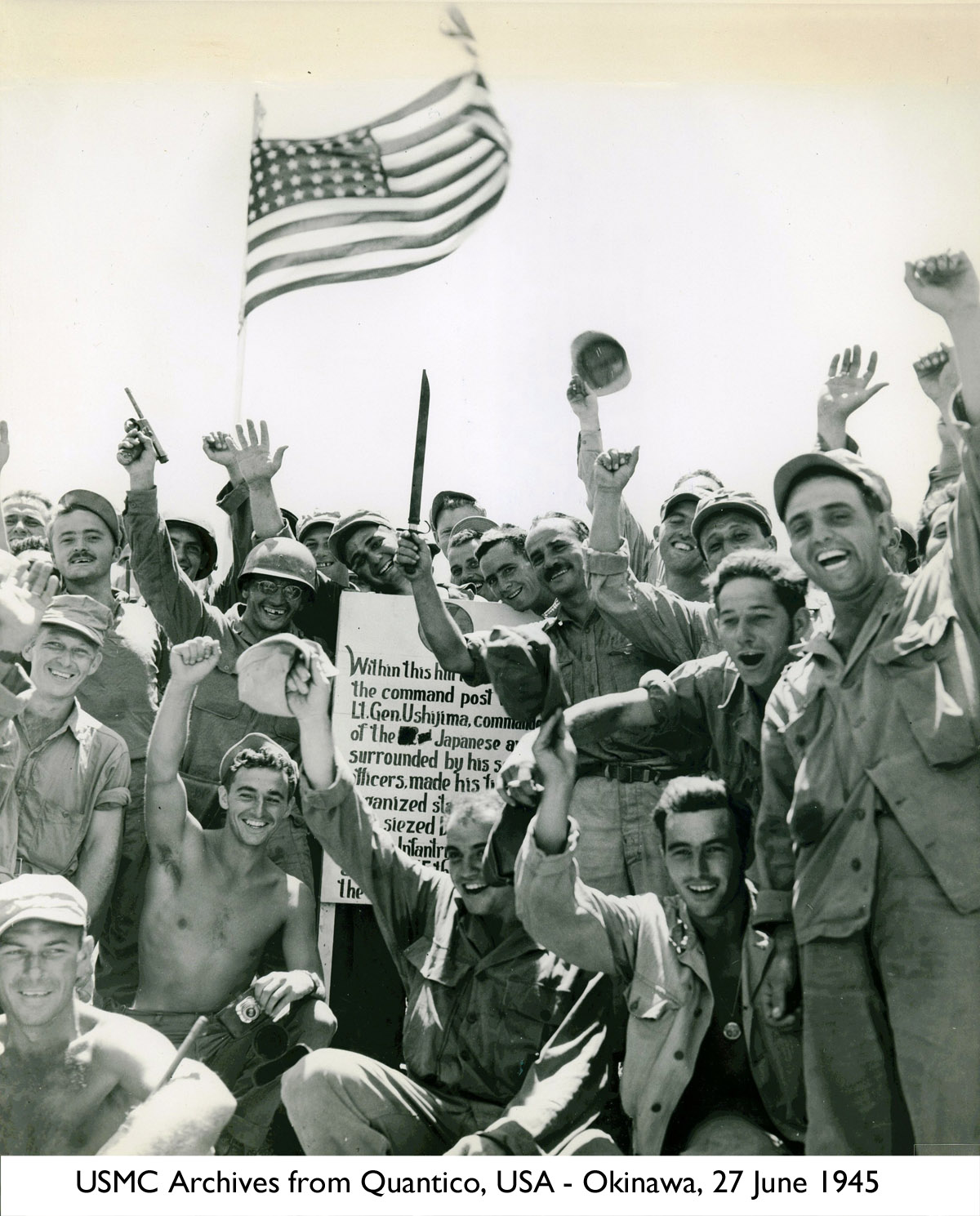
The Pacific island of Okinawa is small, just 67 miles long and 17 miles at its widest point. But at just 350 nautical miles from the southernmost Japanese island of Kyushu, it was a critical target for Allied forces in the Pacific Theater of World War II. June 2025 marks the 80th anniversary of its capture and the conclusion of the last major battle of World War II.
This month marks the 80th anniversary of its capture and the conclusion of the last major battle of World War II.
The Allied powers' strategy of amphibious invasions and island hopping had proven effective in breaking Japan's defensive perimeter in the Pacific. After capturing Iwo Jima and Okinawa, the planned invasion of Japan, called Operation Downfall, was set to begin, potentially bringing the world-shattering war to an end.
Faced with almost certain defeat against the much larger and stronger Allied forces, Japanese troops hunkered down among the caves and rocky ridges of Okinawa to avoid the advancing Americans and their relentless naval bombardment. Few surrendered, and both sides sustained heavy casualties in the frequent close-quarters clashes. But the grinding advance continued regardless, and the Allies reached the southern tip of the island by June 21 after 82 days.
Japan's last defenses in the Pacific had been destroyed, but at a terrible cost — 12,520 Americans gave their lives, and another 38,000 were wounded. Fearing that Operation Downfall would turn into, an Okinawa from one end of Japan to the other,, President Harry Truman ordered the bombing of Hiroshima and Nagasaki just a few weeks later, and the Japanese surrender soon followed.
Few veterans of the Battle of Okinawa still survive after 80 years, but the 99-year-old Walter LaSota was able to visit Okinawa in March, according to Stripes Okinawa. He saw Toguchi Beach again — the place where he had landed as a young private during a devastating war. But this time, the great-grandfather from Pennsylvania sat in his wheelchair and saw nothing but peace.

Rick Good spent ten years in the newspaper business, including with The News & Observer (Raleigh, NC) and The Greenville News (Greenville, SC). He co-wrote, with Melinda Coleman, Rutledge to Riley: Governors of South Carolina, 1776–Present (Published by The Greenville News), and is the author of Mind Games Trivia #1 (Amazon). He has recently spent 15 years creating original trivia content through Sounds Good Mobile Entertainment and continues that with his new company, SGME Software. He edits The Smart Reader’s money, real estate, and business coverage.