More than just a picture: How images of space are created
In 2019, the Event Horizon Telescope Collaboration published an image that should have been impossible to capture: a black hole swirling at the center of the supergiant Messier 87 (or M87 galaxy).
In 2021, the Collaboration released another image of the same black hole, this time with clearly visible lines that revealed the magnetic forces around it. And in 2022, the Collaboration glimpsed the unseen once again with the first image of Sagittarius A, the black hole at the center of our own Milky Way galaxy.
But it takes more than a powerful telescope to see a black hole. It takes a lot of telescopes — so many that together, they function like a telescope as big as Earth itself. To truly "see" a black hole, Event Horizon researchers meticulously synchronized eight observatories in six locations around the world to capture images at just the right time and observe the target area at the correct wavelength. It took an additional two years for EHT researchers to process the mountains of data and find what they were looking for — the accretion disk, a swirling current of matter and energy that often surrounds black holes. And that first image, which may not seem like much at first, was the first visual confirmation that black holes did indeed exist.
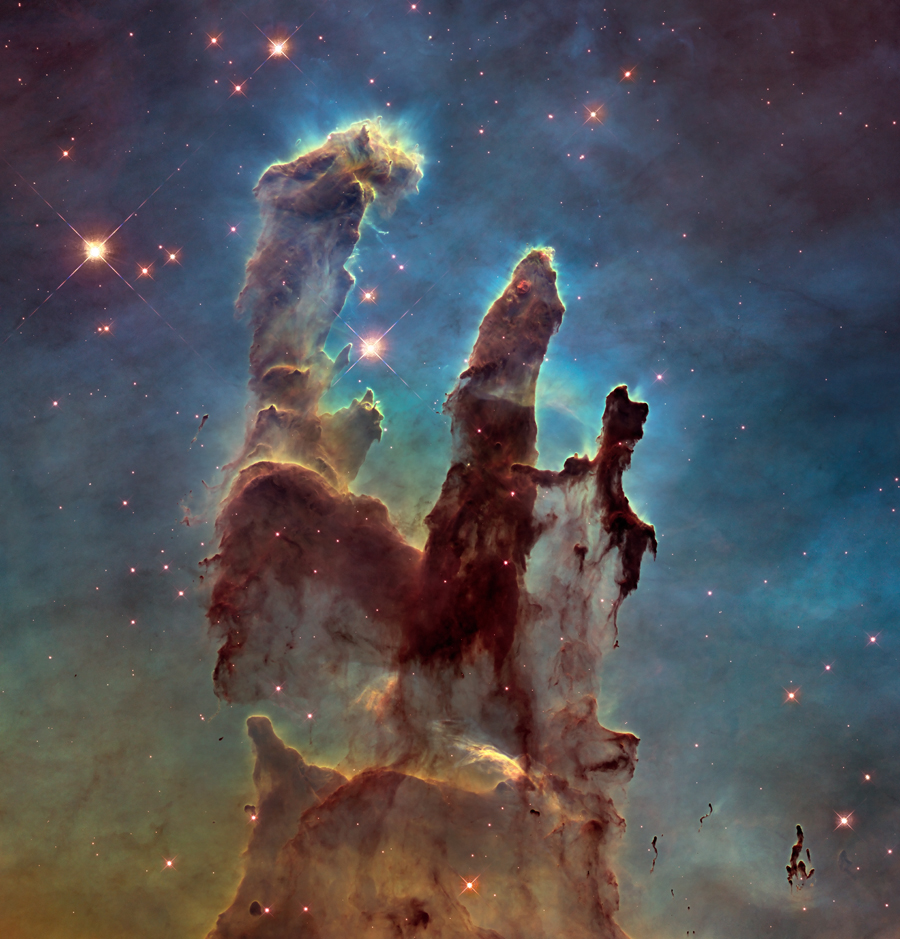
Even images from the powerful James T. Webb telescope are more complicated than simply taking a color photo of space. This enormously complex scientific instrument, which captures more light than our eyes or screens can process and orbits about a million miles from Earth, contains numerous filters to detect different things — for example, hydrogen or gamma radiation. The telescope sends buckets of data back to Earth, which can quickly be interpreted into black-and-white unprocessed images.
But color images are considerably more complicated. For any image, specialists must resize and compress the picture and use a mathematical function to re-interpret brightness — just to make something that our eyes can see. Then, Webb staff remove artifacts (like random lines in the background) to make the image clearer. Colors are usually a result of two or more layers — each from different filters or wavelengths — stacked on top of each other to create something that our eyes and brains can see.
If you're disappointed that those images aren't exactly as they would appear in space, well, don't be. The published pictures are special in their own way, and perhaps even greater than the sum of their parts.

Rick Good spent ten years in the newspaper business, including with The News & Observer (Raleigh, NC) and The Greenville News (Greenville, SC). He co-wrote, with Melinda Coleman, Rutledge to Riley: Governors of South Carolina, 1776–Present (Published by The Greenville News), and is the author of Mind Games Trivia #1 (Amazon). He has recently spent 15 years creating original trivia content through Sounds Good Mobile Entertainment and continues that with his new company, SGME Software. He edits The Smart Reader’s money, real estate, and business coverage.