
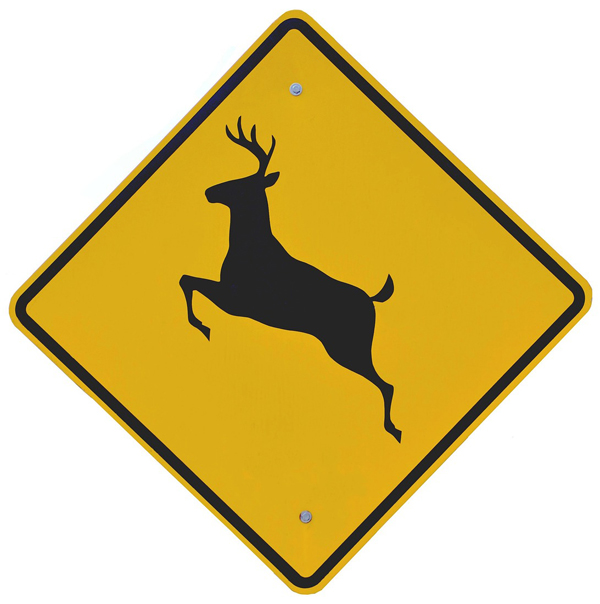
Deer collisions are dangerous and can sometimes be deadly.
The annual insured losses of deer-vehicle collisions in the United States is more than $1 billion. About 1.5 million deer-car accidents happen every year. West Virginia has the highest risk, where one in 37 drivers will have a deer collision. Missouri is next, with a risk of one in 47. Pennsylvania has a risk of one in 51.
Deer-car accidents cause about 175 to 200 fatalities and 10,000 injuries every year, according to State Farm.
Though the mating season from October to December brings the most crashes, deer are crossing the roads throughout the year and as spring ramps up, beware of does traveling with their young.
Deer crossing signs seem a bit amusing, but drivers should believe them. Deer generally use the same routes each day to find water, food and their resting places. If you are driving when deer are most active — at dawn and dusk, especially from 6 p.m. to 9 p.m. — keep an eye out. Remember that deer travel in groups. When you see one deer, there could be several others coming behind it.
Some drivers avoid roads through forests and areas of heavy brush, where deer can appear suddenly.
Others drive at reduced speed to give them more time to stop and the deer more time to cross.
At night, using high-beam headlights allows the driver more time to spot a deer.
Brake — don't swerve. Swerving to avoid a deer can cause a more serious crash, such as into an oncoming car in another lane, or swerving off the roadway and into a tree or a utility pole. In addition, the animal might turn into your swerve, so you'll still hit it, but you'll have less control of the vehicle.

Rick Good spent ten years in the newspaper business, including with The News & Observer (Raleigh, NC) and The Greenville News (Greenville, SC). He co-wrote, with Melinda Coleman, Rutledge to Riley: Governors of South Carolina, 1776–Present (Published by The Greenville News), and is the author of Mind Games Trivia #1 (Amazon). He has recently spent 15 years creating original trivia content through Sounds Good Mobile Entertainment and continues that with his new company, SGME Software. He edits The Smart Reader’s money, real estate, and business coverage.