Little House on the Prairie showed the wagons, the blizzards, the fevers. It left out the horseshoes.
Frontier settlers packed everything they owned onto a wagon and headed into a landscape that offered no guarantees: no doctor for two hundred miles, no forecast, no way to know if the well would run dry. When you cannot control your circumstances, you find other ways to feel safe. Here are five beliefs settlers leaned on, and a few you probably still recognize.
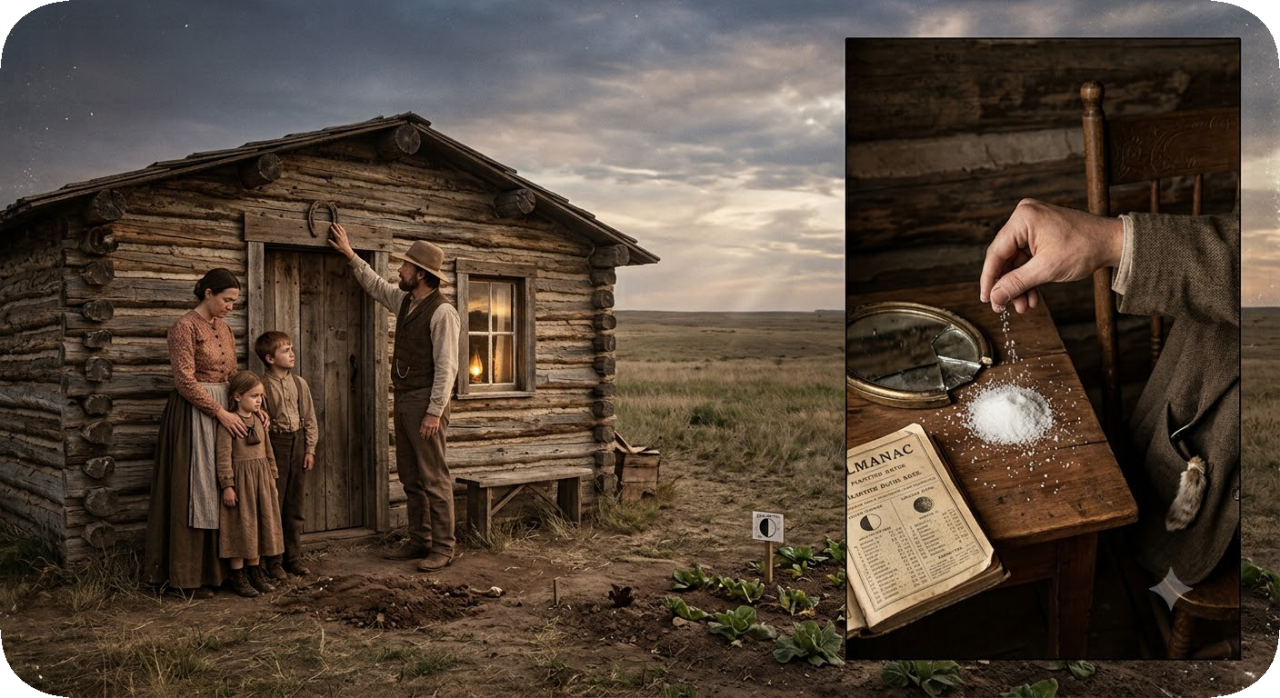
Horseshoes above the door. Settlers nailed a horseshoe over the doorway to keep out witches and bad luck. Hung open-end up, it was believed to catch good fortune. Hung open-end down, it let the luck rain down on anyone who walked through. Either way, nobody was taking chances.
Shoes did double duty. Pioneers hid old ones inside walls, near chimneys, and above ceilings to trap evil spirits before they got into the house. Under the hearth, some buried witch bottles: glass jars packed with nails, hair, and pins meant to destroy evil forces before they reached the family.
Hats that meant business. On the cattle frontier, a cowboy’s hat was not just sun protection. Setting one on the bed was considered terrible luck, sometimes read as an omen of death, a superstition with a grim real-world root: hats were routinely placed on coffins. Store a hat crown-down and the luck was believed to spill straight out.
Inheriting someone else’s boots came with its own risk. Wear them unwashed and you supposedly inherited the previous owner’s bad luck along with the leather. And the one superstition still very much alive: spill salt, and you throw a pinch over your left shoulder to blind whatever evil spirit is lurking behind you.
What happened while you slept. Settlers blamed witches and evil spirits for sleep paralysis, the eerie inability to move right before falling asleep or waking. Bad dreams were not dismissed as noise from the day. According to Oxford Academic, colonial-era nightmares were treated as the original nightmare in the literal sense: supernatural reflections of a sleeper’s deepest wishes and fears, not random static from an overactive brain.
Native people on the frontier had their own defenses. Dreamcatchers, web-like charms strung above a sleeping space, were built to snare bad dreams before they reached the sleeper. Among the Ojibwe in particular, the dreamcatcher’s job extended to protecting infants specifically.
Creatures nobody could quite explain. No list of frontier folklore skips the jackalope, a mythical jackrabbit wearing antlers like a deer, part European tall tale and part Native American legend. It was said to mimic human speech well enough to lure travelers off the trail at night. Some settlers strapped stovepipes to their legs in case of attack, a precaution less absurd than it sounds: a real disease did cause jackrabbits to grow horn-like tumors, giving the myth an actual biological seed to grow from.
Native traditions also told of the Thunderbird, a creature whose wingbeats were said to summon rain, thunder, and change.
Never whistle after dark. Cowboys had one hard rule at night: don’t whistle. Coyotes might hear it and come looking. In the supernatural version, a whistle was an open invitation to whatever evil spirit happened to be listening. Indoors or out, worried about cattle or spirits, the rule held: keep quiet after dark.
Life on the frontier was uncertain in ways most of us will never have to test. Read through these old beliefs and the logic is not hard to follow. When the world is out of your hands, you hold on to whatever gives you a sense of control, even if it’s just a horseshoe nailed over the door.

Rick Good spent ten years in the newspaper business, including with The News & Observer (Raleigh, NC) and The Greenville News (Greenville, SC). He co-wrote, with Melinda Coleman, Rutledge to Riley: Governors of South Carolina, 1776–Present (Published by The Greenville News), and is the author of Mind Games Trivia #1 (Amazon). He has recently spent 15 years creating original trivia content through Sounds Good Mobile Entertainment and continues that with his new company, SGME Software. He edits The Smart Reader’s money, real estate, and business coverage.