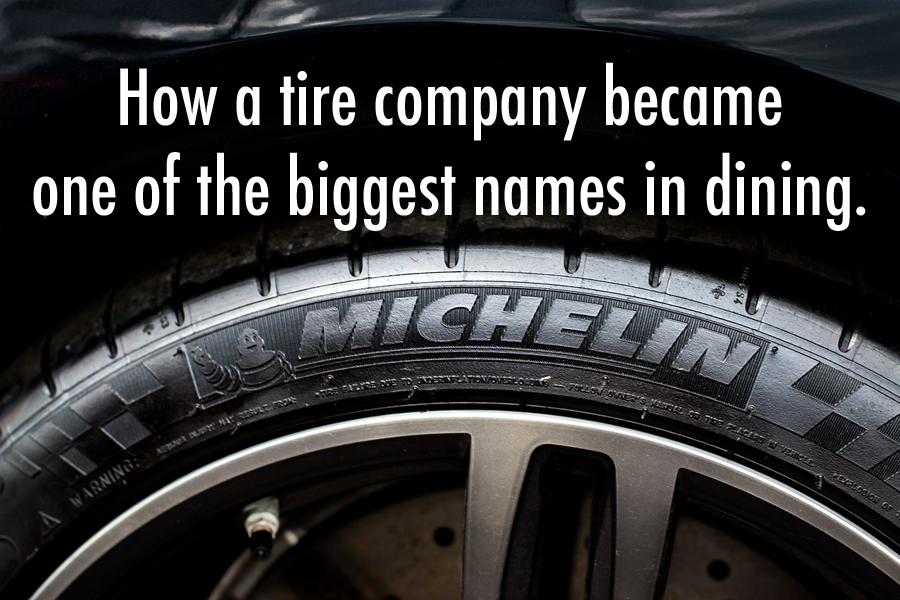
Michelin Stars are one of the most coveted awards in the food industry. But have you ever stopped to ponder how a tire company became one of the most renowned names in the restaurant business? Turns out that the so-called Michelin Guide is one of the best examples of complementary goods.
In economics, a complementary good is something that, once sold, will generate demand for other related products. For example, if you buy a coffee maker, there's a good chance that you'll buy coffee filters as well. That makes coffee makers and coffee filters complementary goods.
In the early 20th century, the Michelin brothers were building a tire business. Yet while the future for automobiles looked bright, cars were still quite rare. Among other factors, many people didn't see a need to travel long distances and thus didn't need an automobile. This put a crimp on the demand for the Michelin brothers' tires.
To spur demand, the Michelin brothers set out to convince Americans that they should hit the road. This would be no small feat because traveling back then was daunting. Simply finding a good place to eat or somewhere to fill up on gas could become quite the burden. With that in mind, Michelin launched the Michelin guide, which contained listings of the best places to eat, sleep, and refuel.
Michelin started by giving their guides away for free. After all, they weren't trying to sell books — just the tires. While it's hard to pin down just how much the Michelin Guide contributed to the adoption of the car, the automobile industry expanded at breakneck speed. Today, consumers can use their smartphones and the web to hunt down restaurants and the like. Regardless, obtaining a Michelin star can be a huge for restaurant owners.

Rick Good spent ten years in the newspaper business, including with The News & Observer (Raleigh, NC) and The Greenville News (Greenville, SC). He co-wrote, with Melinda Coleman, Rutledge to Riley: Governors of South Carolina, 1776–Present (Published by The Greenville News), and is the author of Mind Games Trivia #1 (Amazon). He has recently spent 15 years creating original trivia content through Sounds Good Mobile Entertainment and continues that with his new company, SGME Software. He edits The Smart Reader’s money, real estate, and business coverage.