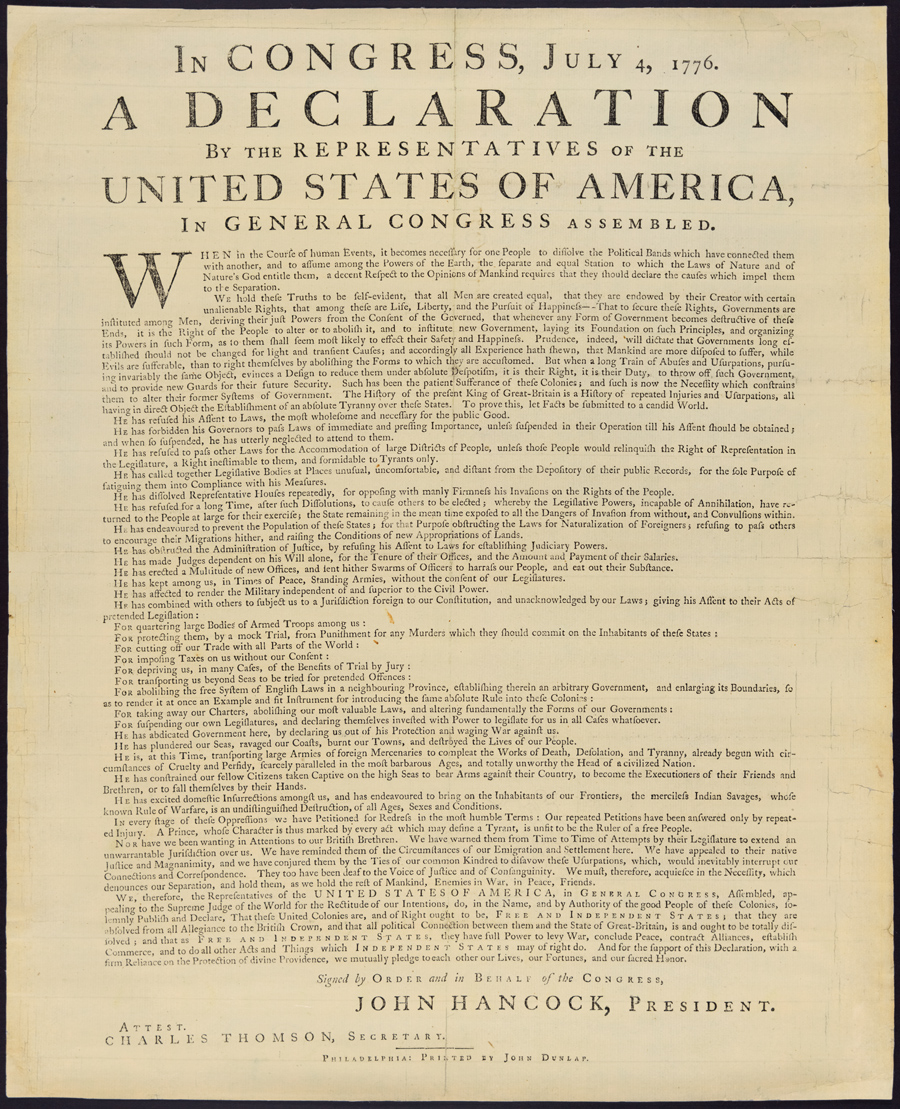
The night the Declaration was signed in 1776, a printer named John Dunlap was asked to make 200 copies (some say 500) of the Declaration to be distributed throughout the 13 British colonies in America.
This document would not be welcome news to the British, so Dunlap hastily prepared and printed the broadside for distribution.
During the next 200 years, nearly all copies were lost. Some of the original colonial families held onto their copy of the broadside and passed it down to their heirs. Only 26 copies of the Dunlap Broadsides are known to survive today.
The most famous recent find of the broadside occurred in 1989 when a financial analyst, browsing a Pennsylvania flea market, came upon a crude painting of a country scene in an ornate frame. Thinking the frame might be worth something, the man tore away the painting, only to find that the frame was worthless. But, behind the painting he saw a paper folded into the size of a business envelope, according to the New York Times.
A friend urged him to get it appraised.
Selby Kiffer, a printing specialist at Sotheby's, told the New York Times in 1991 that it turned out this was a first-printing copy of the Declaration. It was, astoundingly, in superior condition. It appear the Broadside was still wet when it was folded. The first line of the Declaration shows up in reverse at the bottom margin — evidence that Dunlap wasted no time distributing the Broadsides.
The collector who spent $4 on the painting (Donald J. Scheer) in 1989 sold the document for more than $2.4 million. A consortium led by Norman Lear later bought the document for $8.14 million.

Rick Good spent ten years in the newspaper business, including with The News & Observer (Raleigh, NC) and The Greenville News (Greenville, SC). He co-wrote, with Melinda Coleman, Rutledge to Riley: Governors of South Carolina, 1776–Present (Published by The Greenville News), and is the author of Mind Games Trivia #1 (Amazon). He has recently spent 15 years creating original trivia content through Sounds Good Mobile Entertainment and continues that with his new company, SGME Software. He edits The Smart Reader’s money, real estate, and business coverage.