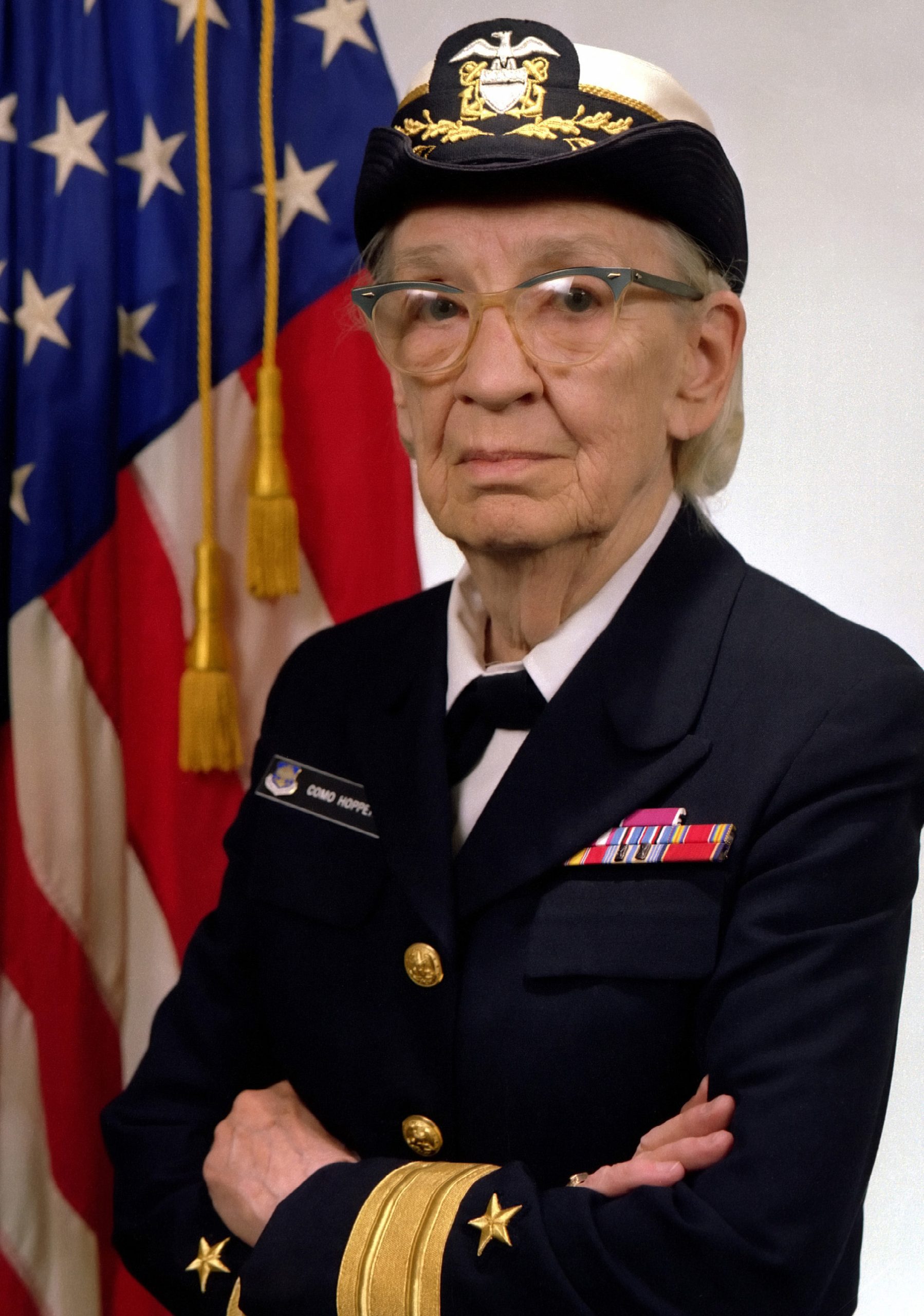
In an industry given to handwringing over the few women in its ranks, computer software technology was actually pioneered by a woman, Dr. Grace Murray Hopper, born in December 1906.
Hopper was a woman of unique persistence and desire.
The oldest of three children born to an upper middle-class family in New York City, by age 19, Hopper graduated at the top of her class at Vassar College with a degree in mathematics. She earned her Ph.D. in mathematics in 1934 from Yale, even though at the time the university did not admit women. She was one of 30 women in the nation to earn a Ph.D.
After Pearl Harbor, she applied to join the Navy for the first time in 1941 and she was rejected as too small (just 5'2" and less than 100 pounds) and, later, was again rejected as too old at age 36. Nonetheless by 1943, the Navy waived the weight requirement and assigned her to the new MARK I computer at Harvard University, as the second in command of a dozen young mathematicians.
It was there that she came up with the idea of writing down common bits of code and storing that code on the MARK I. She called them subroutines. Then she figured, that she could instruct the computer to call the desired routines, and execute the command. That idea she called a 'compiler' — a fundamental concept in computer code today.
"I had a running compiler and nobody would touch it, because, they carefully told me, computers could only do arithmetic, they could not write programs," she said in a 1986 interview with the New York Times. "It was a selling job . . .people are allergic to change . . ."
Hopper retired and rejoined the Navy three times until retiring permanently in 1986. She earned numerous awards during her life, including the Computer Science Man-of-the Year Award, awarded with no irony in 1969.
She is often remembered for explaining the speed of a nanosecond. She claims she called to the engineering department and told them to cut off a nanosecond and send it to her. She received an 11.8 inch length of telephone wire, representing the maximum distance an electrical current could travel in a billionth of a second.
Hopper died in 1992 at her home in Arlington, Virginia

Rick Good spent ten years in the newspaper business, including with The News & Observer (Raleigh, NC) and The Greenville News (Greenville, SC). He co-wrote, with Melinda Coleman, Rutledge to Riley: Governors of South Carolina, 1776–Present (Published by The Greenville News), and is the author of Mind Games Trivia #1 (Amazon). He has recently spent 15 years creating original trivia content through Sounds Good Mobile Entertainment and continues that with his new company, SGME Software. He edits The Smart Reader’s money, real estate, and business coverage.