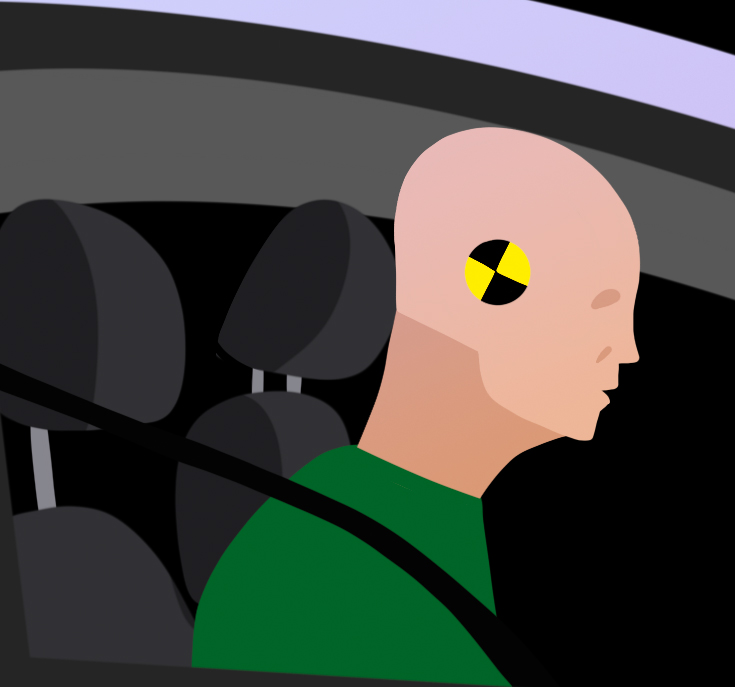
Since the 1970s, crash dummies have been the main tool for researchers interested in testing vehicle safety features, but the dummies were built mainly as proxies for male bodies.
Now, Swedish engineers are developing a version that more closely approximates females.
Women are more likely to die or be injured in crashes and suffer whiplash injuries, according to U.S. government data.
Researchers have always used smaller dummies to research the effects of crashes on women. Typically the dummy is a scaled down in size, about the same as a 12-year-old girl. Those dummies are 4 feet, 8 inches tall and weigh about 75 pounds. That represents the smallest 5 percent of females in the 1970s.
Astrid Linder, director of traffic safety at the Swedish National Road and Transport Research Institute, says their team has developed a dummy that is more representative of the female population at 5 foot 3 inches and 97 pounds. The team also hopes to account for differences in the shape of the torso, center of gravity and outline of the hips and pelvis.
The research is important because more accurate representations can lead to safer cars, airbags and seatbelts, according to the BBC.

Rick Good spent ten years in the newspaper business, including with The News & Observer (Raleigh, NC) and The Greenville News (Greenville, SC). He co-wrote, with Melinda Coleman, Rutledge to Riley: Governors of South Carolina, 1776–Present (Published by The Greenville News), and is the author of Mind Games Trivia #1 (Amazon). He has recently spent 15 years creating original trivia content through Sounds Good Mobile Entertainment and continues that with his new company, SGME Software. He edits The Smart Reader’s money, real estate, and business coverage.