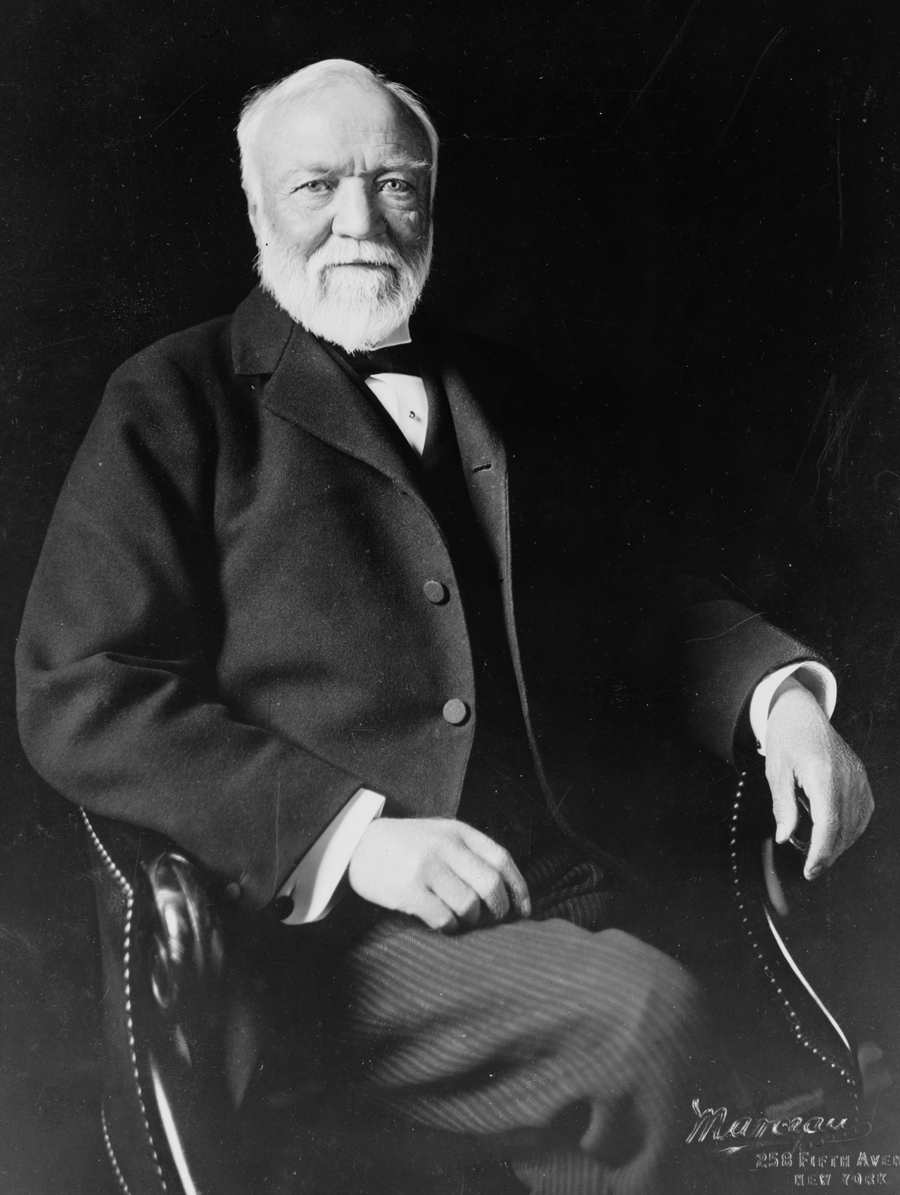
Perhaps no one pulled on his own bootstraps as hard as the legendary industrialist Andrew Carnegie.
Carnegie built America's steel industry, but he grew up in grinding poverty. Born in 1835 in Scotland, Carnegie and his poor working-class family shared a one-room weaver's cottage with another family. In 1848, the family decided to gamble on the U.S. and moved to Pennsylvania in search of a better life.
As a young man, Carnegie worked for pennies in the textile industry and later as a telegraph messenger. A hard worker, he rose superintendent of the Western Division of the Pennsylvania Railroad by age 24, earning $1,500 a year (about $50,000 today), and establishing himself an important cog in the booming railroad industry. During the Civil War, Carnegie was appointed the superintendent of the Union's military railways.
Around the same time, Carnegie started investing in railway projects and emerging oil companies. The Civil War created a huge demand for iron and steel, so Carnegie began investing in that industry as well. After the war, Carnegie focused on the steel industry. Steel was in high demand for rail lines and bridges, and Carnegie was able to leverage this demand into a steel empire.
Carnegie revolutionized the steel industry with his full embrace of the Bessemer process, which burns away impurities in pig iron to make lighter, stronger, and cheaper steel. At its peak, Carnegie Steel was the largest producer of pig iron, steel rails, and coke.
When he died in 1919, he was the richest man in America, but he also believed that "the man who dies thus rich dies disgraced." Carnegie ultimately gave away 90 percent of his wealth to build what would become Carnegie Mellon University, as well as more than 2,500 public libraries.

Rick Good spent ten years in the newspaper business, including with The News & Observer (Raleigh, NC) and The Greenville News (Greenville, SC). He co-wrote, with Melinda Coleman, Rutledge to Riley: Governors of South Carolina, 1776–Present (Published by The Greenville News), and is the author of Mind Games Trivia #1 (Amazon). He has recently spent 15 years creating original trivia content through Sounds Good Mobile Entertainment and continues that with his new company, SGME Software. He edits The Smart Reader’s money, real estate, and business coverage.