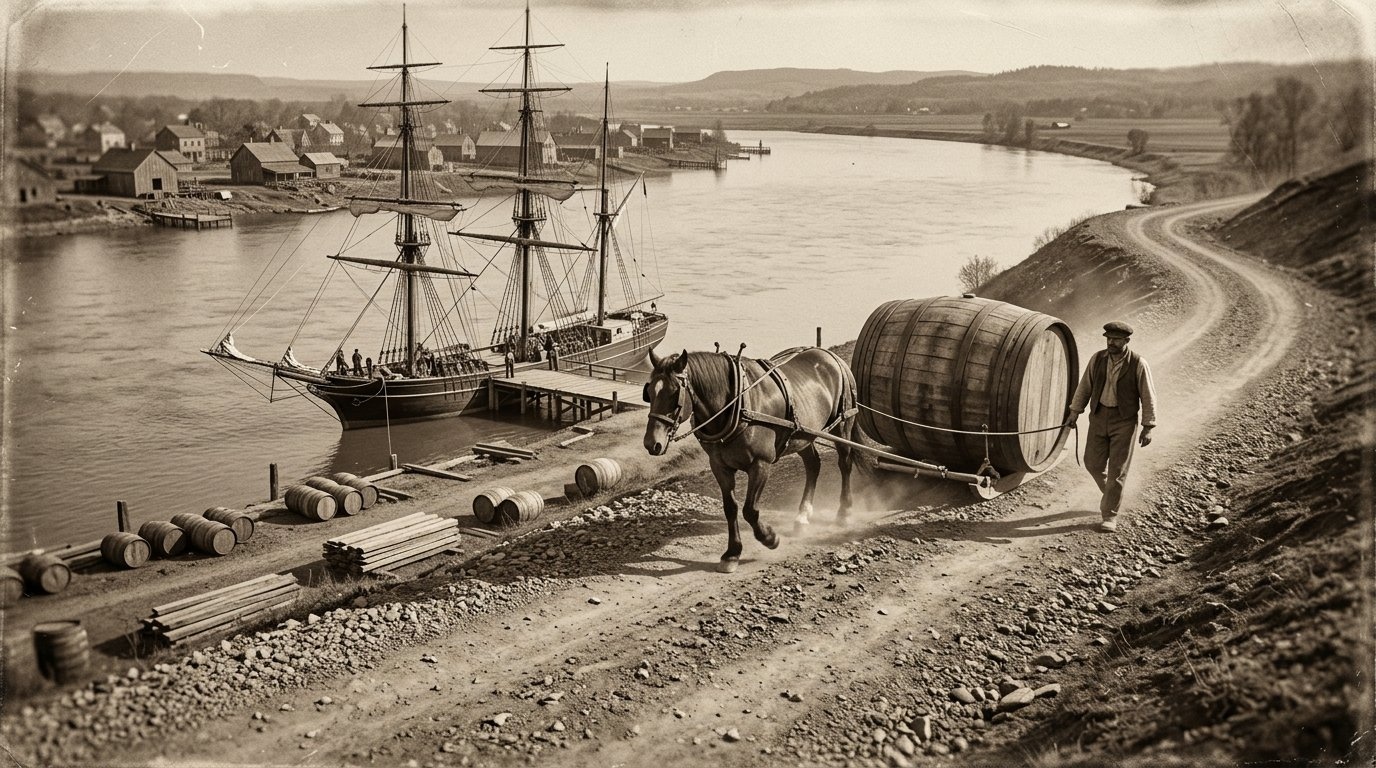
Ocean ships at the front door
In colonial Virginia, you did not need to live near a port. The port came to you.
According to Virginia Places, the deep tidal channels of the James, York, Rappahannock, and Potomac rivers ran 19 to 20 feet deep, plenty for ocean-going ships of the era. Plantations were built on "necks," the peninsulas between tidal creeks, and the larger estates had their own wharves. Trans-Atlantic vessels sailed straight up the rivers and tied up at private docks.
The system was efficient for the planter and miserable for the ship. According to Virginia Places, gathering a full load of 300 hogsheads of tobacco, 1,000-pound barrels, sometimes required a ship to spend up to seven unprofitable months in Virginia waters. Captains launched small boats called shallops to collect cargo from smaller wharves nearby.
According to the National Park Service, this meant ordinary colonists met sailors from across the Atlantic almost every year. A planter's child might encounter dialects from Liverpool, Bristol, Rotterdam, or the Caribbean before ever seeing the nearest Virginia town.
There was little reason to build towns at all. According to Virginia Places, the colonial government in London repeatedly ordered Virginians to centralize their settlements. The planters ignored it. With a wharf at the bottom of the field, why haul a 1,000-pound cask of tobacco anywhere else?
George Washington shipped from Mount Vernon. William Byrd II built ships at Westover. The Atlantic, in colonial Virginia, did not stop at the coast.

Rick Good spent ten years in the newspaper business, including with The News & Observer (Raleigh, NC) and The Greenville News (Greenville, SC). He co-wrote, with Melinda Coleman, Rutledge to Riley: Governors of South Carolina, 1776–Present (Published by The Greenville News), and is the author of Mind Games Trivia #1 (Amazon). He has recently spent 15 years creating original trivia content through Sounds Good Mobile Entertainment and continues that with his new company, SGME Software. He edits The Smart Reader’s money, real estate, and business coverage.