




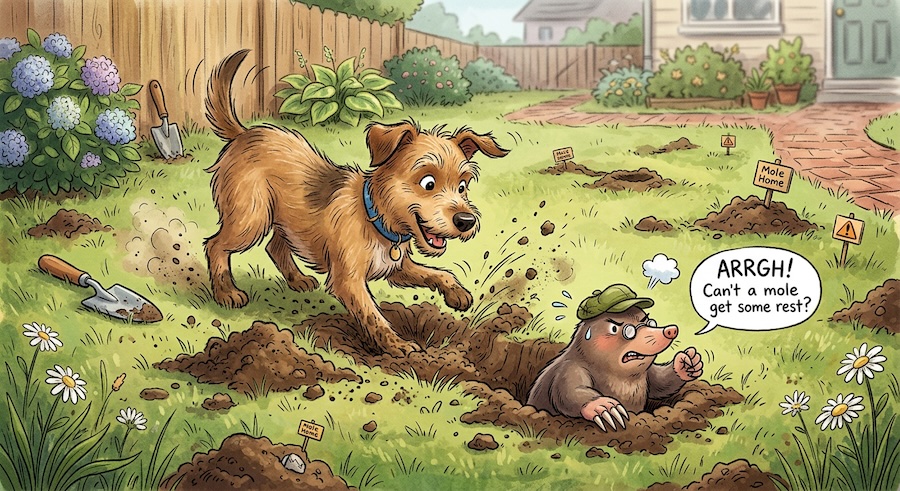
If moles have invaded your yard, you have probably tried repellent sprays, pellets, and those vibrating stakes from the garden center. Here is the hard truth: according to university extension programs from Purdue to Penn State to Michigan State, most of those products do little or nothing. The moles are still there because the products that dominate the store shelves are largely ineffective.
The first surprise is what moles are actually after. Most homeowners assume moles are chasing grubs, and treat their lawns accordingly. But according to Missouri Extension, about 90 percent of a mole’s diet is earthworms, not grubs.
So what does work? Trapping, according to virtually every university extension program in the country. Harpoon traps, scissor traps, and choker traps placed on active runways — the firm, straight tunnels — are the most reliably effective method. Spring and fall are the best times, when moles are tunneling close to the surface.
Poison baits with Talpirid that are designed to mimic earthworms work. Grain-based rodent poisons are useless because moles won’t eat them.
Moles are remarkable diggers — capable of extending a tunnel more than 100 feet in a single day. They are also solitary and territorial, so if you eliminate one, the activity may stop entirely.

Allyson Good curates senior living, health, and family content. She is formerly the Managing Editor of Active Life, a print newspaper published in 2016-2017 for seniors, choosing practical articles on health, money, safety, and everyday living for older readers. She is also an avid gardener and offers up Garden Hints and Tips on a regular basis.