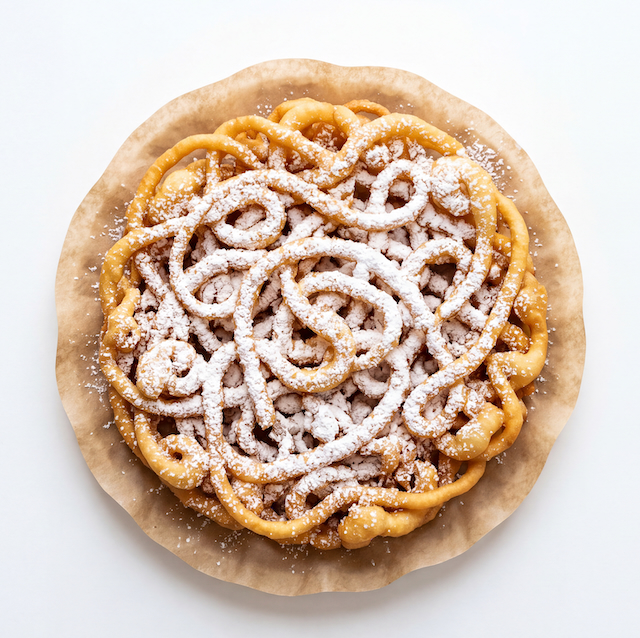
Nobody got rich inventing the funnel cake. That squiggle of fried batter under a blizzard of powdered sugar is a Pennsylvania Dutch folk recipe, carried to America by German immigrants in the 1700s and refined into its modern form around 1879. According to food historians, it only spread nationwide after the Kutztown Folk Festival in Pennsylvania began serving it in 1950. No patent, no royalties. The most famous dessert at the fair belongs to everyone and no one.
What it lacks in an owner, it makes up for in margin. By one concession-industry breakdown, the ingredients in a funnel cake run about 54 cents — roughly 27 cents of batter, a few cents each of powdered sugar and frying oil, and a paper plate. That same cake sells for $5 at a county fair and as much as $10 at a big one. On the food alone, the vendor keeps better than 70 cents of every dollar.
Compare that to a restaurant. According to 2025 industry data, a typical full-service restaurant spends 28 to 35 cents of every sales dollar on ingredients and, after rent, labor, and everything else, nets just 3 to 5 cents. The funnel cake stand carries no year-round lease and no dinner-shift crew. Its ingredients are flour, sugar, and oil, and its customers are already standing in line, captive and hungry.
So can you get rich dreaming up the next fried craze? The steady money is in selling a simple, cheap thing at volume, to the same crowd, year after year. The corn dog is the proof: a Buffalo businessman named Stanley Jenkins patented the deep-fry-on-a-stick machine in 1929, and almost nobody remembers his name. The fortune went instead to brothers Neil and Carl Fletcher, who began selling corny dogs at the State Fair of Texas in 1942 for 15 cents apiece — and flopped so badly at first they had to cut them in half and hand out free samples. Today Fletcher's is a multimillion-dollar, third-generation family business that, by its own count, sold 583,000 corn dogs at a single fair in 2022, with those 24 days making up about 80 percent of its yearly business.

Rick Good spent ten years in the newspaper business, including with The News & Observer (Raleigh, NC) and The Greenville News (Greenville, SC). He co-wrote, with Melinda Coleman, Rutledge to Riley: Governors of South Carolina, 1776–Present (Published by The Greenville News), and is the author of Mind Games Trivia #1 (Amazon). He has recently spent 15 years creating original trivia content through Sounds Good Mobile Entertainment and continues that with his new company, SGME Software. He edits The Smart Reader’s money, real estate, and business coverage.