
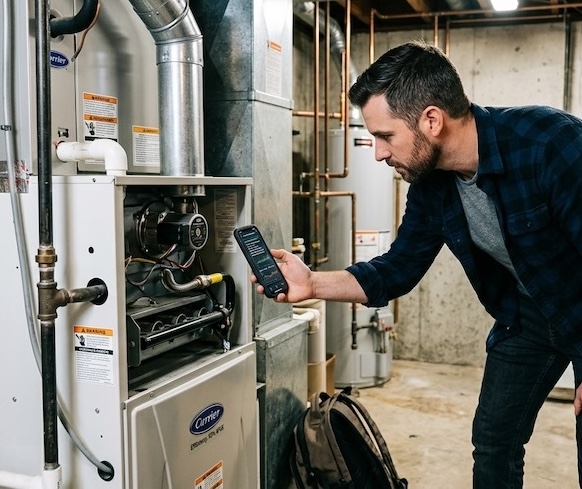
The open house ritual used to be simple: peek in the closets, flush the toilets, squint at the water heater and hope for the best. Then the tech guys showed up with their phones out.
Software engineers shopping for a home have turned the walk-through into a data-collection exercise. One of them, house hunting this summer, photographs the furnace, the air conditioner, the water heater — the boring metal boxes most buyers ignore. He feeds the pictures to an AI chatbot and asks it to read the model plates and serial numbers, estimate how old each unit is, and tell him how many years of service are likely left. Upstairs, he leans out a bedroom window and snaps the roof, then asks the AI to look at the shingles, judge the wear and guess how soon the whole thing will need replacing.
By the time he walks out the front door, he has a rough repair budget in his pocket. A furnace on its last legs is a negotiating chip. A roof with five good years left is a different house than one with fifteen.
He is not alone. About 39 percent of prospective buyers have used AI tools in their home search, according to a Veterans United survey this year. And agents are fielding more and more clients who show up with chatbot-generated price opinions in hand, according to CNBC.
Sellers are trying it too. A Cooper City, Florida, man listed his house $100,000 above what local agents advised, on ChatGPT’s say-so, and had a signed contract at his price in five days, according to Fortune.
The cautions are real. Home inspectors point out that AI repair estimates often lean on stale pricing, and a photograph cannot see a cracked heat exchanger or a soft spot in the roof decking. No chatbot replaces a licensed inspector, and no chatbot has ever crawled an attic in August.
But as a first pass, before the earnest money and the inspection fee, the phone in your pocket has become a surprisingly good flashlight.

Rick Good spent ten years in the newspaper business, including with The News & Observer (Raleigh, NC) and The Greenville News (Greenville, SC). He co-wrote, with Melinda Coleman, Rutledge to Riley: Governors of South Carolina, 1776–Present (Published by The Greenville News), and is the author of Mind Games Trivia #1 (Amazon). He has recently spent 15 years creating original trivia content through Sounds Good Mobile Entertainment and continues that with his new company, SGME Software. He edits The Smart Reader’s money, real estate, and business coverage.